Friday, May 12, 2023

Golems and Owlbears

The Bones 5: Escape from Pizza Dungeons Kickstarter from Reaper Miniatures included several nice sculpts using the Bones Black material. I was particularly looking forward to painting up a pair of new golem models that had been included in the Core Set. Although I already had a few stone golems, I wasn’t completely enamored with them—and I really didn’t have any clay golems. While I’m not certain who sculpted these figures, the stone golem closely resembles an earlier model (77171) credited to James Van Schaik, so perhaps he worked on both.

These golems were some of the first miniatures I used my new airbrush on because they seemed fairly simple. I primed both with the Army Painter spray primer, then used the airbrush to base coat the stone golem with Reaper MSP stone gray. For the clay golem I used a mix of Army Painter airbrush brown and red. The stone golem got a wash with Reaper stone wash, while I used the Vallejo umber wash on the clay golem. After drybrushing highlights on both, I hit the stone golem with Testor Dullcote and used Vallejo gloss varnish on the clay golem to give it a wet look. Overall, I was relatively happy with both.

The Bones 5 set also had a great owlbear figure by Bobby Jackson. Even though I already had a pretty awesome model sculpted by Jason Wiebe from an earlier Bones set, I really wanted to tackle this bad boy. I also primed this with Army Painter gray and then basecoated the model with Army Painter leather brown. I washed it with Vallejo umber and used drybrushing to bring out the highly detailed feathers and fur. In retrospect I wish I had used a higher contrast color scheme on this mini, but it still looks pretty good on the table.

What I like most about this figure is it successfully blends owl and bear components into a fearsome-looking hybrid, but also harkens back to the weird, chonky look of early owlbear illustrations. The Erol Otus owlbear from AD&D Rogue’s Gallery (1980) is a good example of this look, and calls back to David Sutherland’s illustration in the original AD&D Monster Manual., which depicts a creature that doesn’t much resemble either an owl or a bear.

A surprising amount of energy has been spent on trying to track down the origin of this curious creature. The artist Tony DiTerlizzi convincingly demonstrated in his post Owlbears, Rust Monsters and Bulettes, Oh My! that the Sutherland illustration used a Chinasaur toy as a reference. Over at En World Michael Tresca tried to track down the ultimate origin of this toy in his article The Plastic Ancestry of the Owlbear.

Peter Fitz, in his blog Shouting into the Void, has an interesting retrospective: Alas, Poor Owlbear, You Were Great Once. Fitz observes that owlbears in 1e AD&D were truly nasty: they would “attack prey on sight and will fight to the death.” Moreover, they had an iconic attack that got dropped in the transition from 2e to 3e: the dreaded owlbear hug. On a claw attack of 18 or more, “the owlbear has dragged the victim to itself; and the opponent will take an additional 2-16 hit points damage from the hug, that melee round and every melee round thereafter until the owlbear is killed.” Fitz’s post reminded me how truly nasty these monsters could be in earlier editions.

Instead of a hug, 3e gave owlbears the improved grab ability, which is similar in concept to the old owlbear hug but not nearly as dangerous, and the 5e designers dropped this ability altogether. I appreciate the attempt to simplify monster design, I really do—5e monsters are usually far easier for harried DMs to run than their earlier incarnations. But in some cases the 5e approach flattens the monsters until they sometimes just seem like bags of hit points differentiated only by paint job. This CR 3 creature works exactly like this other CR 3, except one is green and flies and one is orange and swims.

Fitz noted that he intended to revise the owlbear to bring back its iconic and interesting abilities, which seems like an excellent idea. To develop my own take on a retro-owl bear, I went back to Moldvay D&D as well as AD&D 1e for guidance. In D&D owlbears (or rather, “owl bears” show up on the both the Level 4–5 and the Level 6–7 Wandering Monster tables. In AD&D owlbears are on the Monster Level IV table, though their XP value (225 + 8/hp) would suggest the average specimen (421 XP) might work better on the Monster Level V table. As standard 5e owlbears are Challenge 3 monsters, I designed my souped-up version for Challenge 5.

The following text is Open Game Content.

Horrible Owlbear

Horrible owlbears are larger and even more vicious specimens of standard owlbears. Highly aggressive and voracious, horrible owlbears attack any living creatures they spy and once engaged will not relent until slain.

Horrible Owlbear
Large monstrosity, unaligned
Armor Class 15 (natural armor)
Hit Points 95 (10d10 + 40)
Speed 40 ft.
StrDexConIntWisCha
20 (+5)12 (+1)19 (+4)3 (-4)12 (+1)7 (-2)
Skills Perception +4
Senses darkvision 60 ft., passive Perception 14
Challenge 5 (1,800 XP)
Keen Sight and Smell. The horrible owlbear has advantage on Wisdom (Perception) checks that rely on sight or smell.
Owlbear Hug. If the horrible owlbear hits a creature with two claw attacks in the same turn, the target is grappled. The horrible owlbear has advantage on beak attacks against a creature it has grappled and may use a bonus action to inflict 14 (2d8 + 5) bludgeoning damage on the grappled creature.
Actions
Multiattack. The horrible owlbear makes three attacks: one with its beak and two with its claws.
Beak. Melee Weapon Attack: +8 to hit, reach 5 ft., one target. Hit: 10 (1d10 + 5) piercing damage.
Claw. Melee Weapon Attack: +8 to hit, reach 10 ft., one target. Hit: 14 (2d8 + 5) slashing damage.

OPEN GAME LICENSE Version 1.0a

The following text is the property of Wizards of the Coast, Inc. and is Copyright 2000 Wizards of the Coast, Inc (“Wizards”). All Rights Reserved.

Saturday, May 6, 2023

Demogorgon, Mandragoron, and More

The Twin Heads of Demogorgon

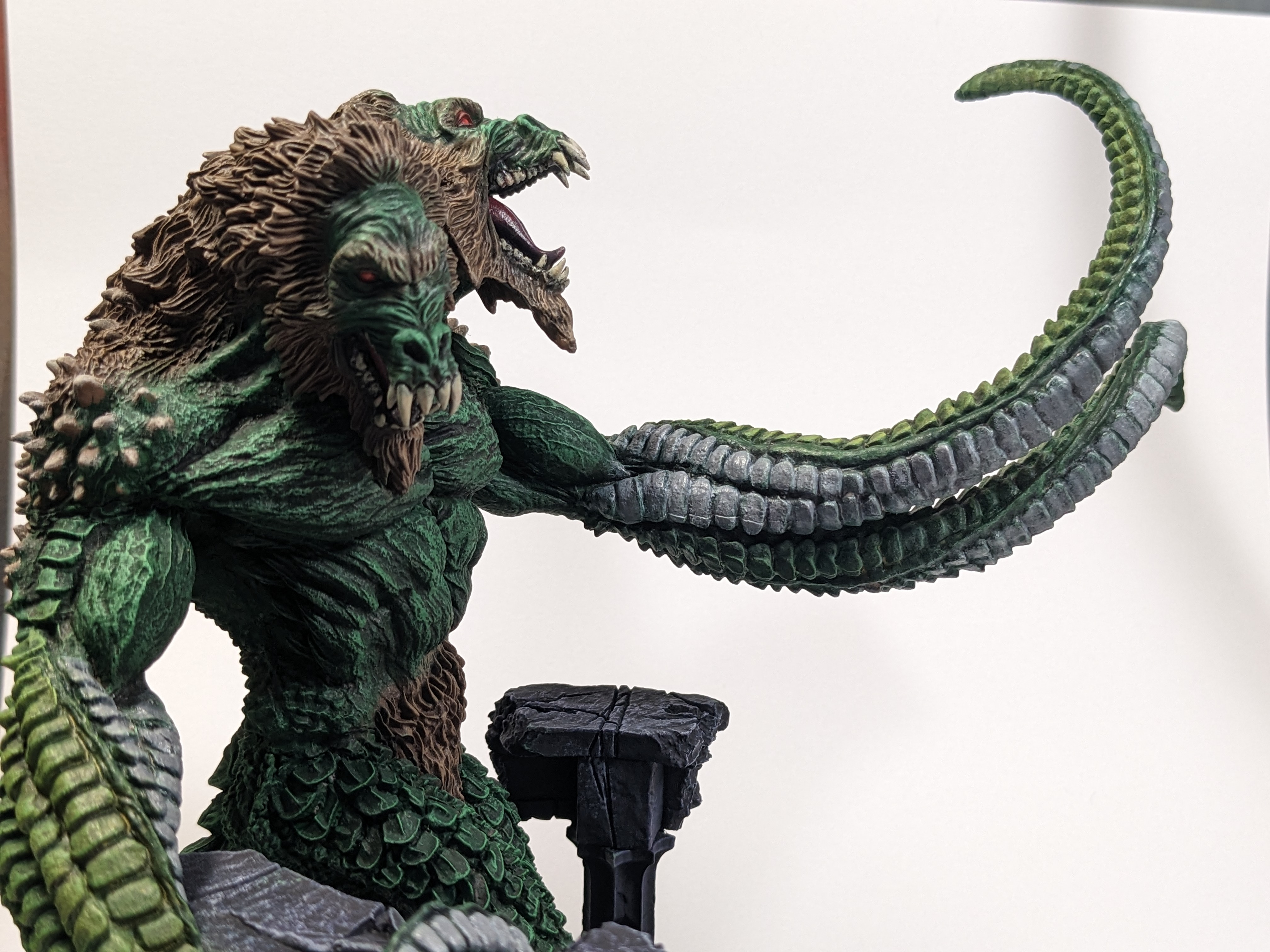
I finally finished painting the Gale Force Nine Demogorgon miniature, though “miniature” is hardly an appropriate descriptor for this gigantic model, which gives the Prince of Demons an appropriate heft amidst 28mm figures. This is an absolutely great sculpt by Charles Woods: from almost any angle, this thing looks fearsome.

The model is made out of resin, which is very different than the Reaper Bones PVC material I’ve primarily been working with. The resin is hard, brittle, and took a lot of washing to get clean. The nice thing about resin is it’s lightweight and retains excellent details with comparatively little flashing or mold lines. The bad thing is it’s fairly rigid, and if two connecting pieces don’t mesh perfectly it’s a lot of work to patch in some Green Stuff to fill the gaps.

Demogorgon in Profile View

I assembled everything according to the GF9 assembly guide and then addressed the gaps, of which there were several. In retrospect, it probably would have been easier to have begun priming and base coats before assembling anything, as several areas in this piece are hard to get at with a brush once all the pieces are in place.

I primed the whole piece using the Army Painter Uniform Gray spray-on primer. This is my go-to general primer. I then began the tedious base painting with a brush. The online painting guide makes an explicit pitch for using an airbrush on this model, and this mini definitely made me realize it was time to break down and get an airbrush rig. Demogorgon himself has a mostly dark green base coat, while the ruins he stands within have a black base coat. It was so hard to get a good, even coat – every time I’d put the brush down I would immediately see half a dozen tiny spots I had missed, particularly in the gaps between the scales and fur.

I did a few washes with Vallejo Umber Wash, but I am curious what using some of the Army Painter Strong Tone would have been like. I was a big fan of the Vallejo wash, but the Army Painter stuff seems to work better for me, particularly on larger models.

I then began the dry brushing and cleanup painting. Dry-brushing was fun: the model has tons of small details, particularly on the scales, and it felt very satisfying to see these details emerge. (I did burn through several brushes in the process.)

It felt like cleanup on this model took forever. I am altogether much too fussy for my relatively low skill level but I just can’t rest until I’ve knocked down all the blemishes I can find. I followed the GF9 painting guide for the most part, but didn’t want to try the fiery split chest effect.

Comparison of Demogrogon miniature against a 28mm figure

I had bought this model for the conclusion of my Out of the Abyss campaign, and was looking forward to dropping him on the board for the climactic battle. I got him close enough for this purpose, but unfortunately COVID prevented us from playing the finale out in person. Demogorgon got boxed up for months as I moved on to other projects.

Finally, the new airbrush inspired me to work through my backlog. I was too far along with this model to use the airbrush, but because the rest of my workflow was moving again I was able to return and finish out this model. I used some different glazes on the tentacles to help vary the green-and-brown color scheme, and then varnished everything with Testor’s Dullcote spray lacquer, my go-to varnish. I added some Vallejo gloss varnish to the teeth, mouth, and tentacles to give them a little slimy look.

Overall, I’m very happy with the results even though the process I took was much too long and laborious. It’s an absolutely great looking sculpt and I hope I did it some measure of justice.

Demogorgon in the Great Dungeon

Demogorgon

The Great Dungeon of the North calls out to the followers of many demon princes, offering lost treasures, magic, and dark secrets. What little is known of Demogorgon was carried out of the Distant West, where conjurers are said to have mastered the foul art of commanding and binding demons. There Demogorgon is widely considered to be, if not the supreme demon prince in the Abyss, certainly one of the most powerful. 

Several areas within the Great Dungeon are infected with a slowly-spreading demonic taint that steadily warps the affected areas with evil and chaos. In these infected sites gates to the Abyss spontaneously open and close like suppurating wounds, allowing demons to enter the Dungeon—and occasionally drawing the unwary into the Abyss that awaits beyond.

Several years ago the lesser demon lord Mandragoron, a valued servant of Demogorgon, disappeared on the deepest levels: he is rumored to have been swallowed up by the Great Dungeon. Today vassals of Demogorgon, commanded by a powerful demon queen, are said to have established a stronghold somewhere in the lowermost halls.

The image of Mandragoron below was generated using Dall-E 2. The following text is Open Game Content.

Mandragoron

Mandragoron, a giant baboon with raven wings

Mandragoron is a unique demon who, while not as powerful as one of the great princes of the Abyss, is nevertheless a terrible foe and justly loathed by the forces of good. He is allied with the mighty Demogorgon, the Prince of Demonium, and the two demons are sometimes said to be related, though the exact nature of this relationhip—sibling, spawn, or other—has never been established.

Mandragoron appears as a giant baboon with long yellow fangs and tattered raven wings, his fur and feathers filthy and patchy.

Mandragoron
Large fiend (demon), chaotic evil
Armor Class 20 (natural armor)
Hit Points 253 (22d10 + 132)
Speed 40 ft., fly 80 ft
StrDexConIntWisCha
23 (+6)14 (+2)23 (+6)17 (+3)15 (+2)19 (+4)
Saving Throws Dex +9, Con +13, Int +10
Skills Intimidation +11, Perception +9
Damage Resistances cold, fire, lightning
Damage Immunities poison; bludgeoning, piercing, and slashing that is nonmagical
Condition Immunities charmed, exhaustion, frightened, poisoned
Senses truesight 120 ft., passive Perception 19
Languages all, telepathy 120 ft.
Challenge 21 (33,000 XP)
Innate Spellcasting. Mandragoron’s spellcasting ability is Charisma (spell save DC 21). He can innately cast the following spells, requiring no material components:
At will: detect magic
3/day each: darkness, dispel magic, fear
1/day: teleport
Legendary Resistance (3/Day). If Mandragoron fails a saving throw, he can choose to succeed instead.
Magic Resistance. Mandragoron has advantage on saving throws against spells and other magical effects.
Magic Weapons. Mandragoron’s weapon attacks are magical.
Noxious. Mandragoron constantly sheds patches of filthy fur and feathers that crawl with abyssal vermin. Any living creature that starts its turn within 10 feet of Mandragoron must make a DC 21 Constitution saving throw. On a failure, the creature is poisoned until its next turn.
Actions
Multiattack. Mandragoron makes three attacks: one with his bite and two with his claws.
Bite. Melee Weapon Attack: +13 to hit, reach 5 ft., one target. Hit: 13 (2d6 + 6) piercing damage plus 11 (3d6) poison damage.
Claw. Melee Weapon Attack: +13 to hit, reach 10 ft., one target. Hit: 13 (2d6 + 6) slashing damage.
Legendary Actions
Mandragoron can take 3 legendary actions, choosing from the options below. Only one legendary action option can be used at a time and only at the end of another creature’s turn. Mandragoron regains spent legendary actions at the start of its turn.
Bite Attack. Mandragoron makes a bite attack.
Detect. Mandragoron makes a Wisdom (Perception) check.
Wing Attack (Costs 2 Actions). Mandragoron beats his wings. Each creature within 15 feet of the demon must succeed on a DC 21 Dexterity saving throw or take 13 (2d6 + 6) bludgeoning damage and be knocked prone. Mandragoron can then fly up to half his flying speed.

OPEN GAME LICENSE Version 1.0a

The following text is the property of Wizards of the Coast, Inc. and is Copyright 2000 Wizards of the Coast, Inc (“Wizards”). All Rights Reserved.

Saturday, April 22, 2023

The Return of the Great Dungeon

Well, that was one heck of summer hiatus. Back in early March I finally turned in the big project I had been working on last year. It's tentatively scheduled for publication later this year. I don’t want to jinx anything by saying too much just yet, but I will say that writing this book was an engrossing and ultimately enjoyable endeavor.

The one downside: working on such a massive project ate up much of the limited bandwidth I have for gaming. So I didn’t run any new games, and the one game I was playing in finished in July. I didn’t paint any miniatures and of course this blog laid fallow in the interim.

Cover of the Tournament of Pigs

Since turning in the project I’ve tried to make up for lost time. Back in February I ran a group through the Tournament of Pigs over a long weekend. This is a nice boxed set with many high quality components. The premise is the players take “the role of commoners trapped in a medieval game show competition.” The tone is tongue-in-cheek and the action is wild and pretty much non-stop.

The Tournament was designed with the Dungeon Crawl Classics RPG in mind. I’ve long wanted to check out DCC, a gonzo, old-school system with a heavy metal/sword-and-sorcery aesthetic. One of DCC’s signature features is the Funnel, wherein players create several zero-level characters that are then run through a mechanical meat grinder: the survivors emerge as the starting first level characters. The Funnel is an interesting game mechanic: it emphasizes the high lethality of the system, while producing a PC background a little like the lifepath system from Traveller, including the old school “death in character generation” option. The Tournament of Pigs is a literal funnel of up to twelve different events, ranging from conventional gladiatorial combat to races and talent competitions.

The Tournament has been ported to the 5e D&D system, which is the version I used. Rules for zero level 5e characters seem to work pretty well. The adventure appears to work best with larger groups, with each player running four different characters. Although the rules recommended a maximum of eight players, at different times we had as many as ten, but the Tournament still seemed to work fine even with a slightly larger group.

I had a blast running the Tournament and the players seemed to have a good time as well. The different events are varied, inventive, and completely demented. I would encourage prospective DMs and players to fully embrace the zany tone in order to get the most value out of the experience. It was the perfect weekend one-shot for a large group, and has gotten me interested in looking at more products for DCC.

In the last couple of months I’ve also started running a weekly group through the Dancing Hut of Baba Yaga, a loose 5e update of the classic AD&D 1e adventure by Roger Moore, which appeared in the pages of Dragon 84 (March 1984). I subscribed to the magazine at the time and received this issue in the mail, and have hankered to run this “no-holds-barred challenge for high-level AD&D characters” ever since.

The players for this adventure all participated in a weekly 3.5e D&D game from 2005–2009 that was intended to be my D&D bucket list, including conversions of classics like Keep on the Borderlands, Isle of Dread, White Plume Mountain, Against the Giants, Descent into the Depths of the Earth, Vault of the Drow, and Kingdom of the Ghouls. The players converted their old characters from that campaign to 13th-level 5e versions. We’ve only had a few sessions so far but it’s been nice to get the old band back together.

Finally, I’ve started painting miniatures again after a long pause. I was so busy running and playing in D&D games during COVID that I never had time to pick up the paints. (And since most of the games were virtual anyway, what was the point?)

But I finally took the plunge and bought an airbrush. I had built up an extremely daunting backlog of very cool, but very large miniatures going back to the Reaper Bones 3 Kickstarter. Painting the titanic Gale Force 9 Demogorgon miniature really broke me. I also really want to paint the Type U Armed Packet model from the 2nd Dynasty Kickstarter, and I just didn’t see being able to do a decent job on a starship with brushwork. 

An airbrush was a significant investment, and I’m still very low on the learning curve, but I can already see the benefits. It’s certainly helped break up my logjam. If the only thing I do with the airbrush is priming, base coats, and varnishing, it should greatly speed up my production cycle. I can now base coat a simple model in 5 or 10 minutes that might have taken me an hour or more. I’m trying to build up my skills enough to finally tackle my own private Everest: the Reaper Tiamat Ma’al Drakar the Dragon Tyrant model.

Tuesday, May 24, 2022

Sumer is Icumen in

After spending the last eight months poking around Dark Nebula and the Aslan Hierate, I’m going to step back for a while to finish up a fairly large and exciting project that will utilize some of the material I’ve been developed here. Accordingly, I’ll be posting a little more sporadically over the summer. Most of the posts, like this one, will be miscellanies.

* * * * * *

I’ve been itching for another regular D&D game for the last six months, and I recently started playing in a weekly 5e game on Roll20. It’s a homebrew viking game and has been a blast so far.

We’ve got a gigantic group with three berserkers, so there’s no shortage of raging. This is my first chance to play a 5e barbarian and like all the classes I’ve tried the mechanics are simple but fun—there’s almost always something interesting to do no matter the opponent. Right now we are trying to deal with a cursed greataxe.

* * * * * *

Second Dynasty armed packet miniatures

A few months ago I backed the Traveller RPG Starship Miniatures kickstarter by 2nd Dynasty, which produced a series of 3D-printer files of classic Traveller ships. Ian Stead worked on many of the designs, which are really stunning. 

Of course, I was sold by the inclusion of a Type U armed packet. My initial plan was to finally buy myself a 3D printer and start churning out my own models. But alas, I have been too busy working on my big project to really jump into a completely new hobby.

Fortunately, Arthiarn Gaming is an Etsy store licensed to print 2nd Dynasty designs. I ordered a copy of the armed packed in both 1-inch and 1/270 scale, and my package arrived last week.

The purchase was well worth it: the Type U can look a bit ungainly from certain angles and is best appreciated in three dimensions. The quality of both sculpts is quite high: there’s plenty of small detailing to add considerable interest to the model. And at 1/270 scale, the packet has a satisfying heft while still being able to fit comfortably in one hand.

Similarly, the quality of the print is very good, comparable to what I’ve gotten from Fantasy Forge. There were only a few bits and bobs that needed trimming, but the material is soft enough to easily work with. One small section of a wing on the 1 inch model was a little ragged, but sanded down smoothly. 

I haven’t tried to paint a starship model before, and after years of painting bones, scales, blood, and ghoul flesh I’ll need to research how to do a good job with clean lines, futuristic materials, and reflective surfaces.

Being able to look at the ship in three dimensions has also made me want to revisit my deckplans for the armed packet. With Mongoose Publishing’s revised High Guard Update scheduled for release in July it might be high time to take one more crack at this ship…

Tuesday, May 17, 2022

Syareahtaorl: The Loakhtarl Clan

Taorl-class starship
“The flowing lines and multiple subhulls of the Aslan Taorl-class Exploratory Merchant (RL-KS13) are characteristic of most ihatei ships. The color scheme and inscriptions identify this ship as associated with Clan Loakhtarl” (T5 v5.1).

Having untangled some of the Wahtoi’s tangled history, let’s take a look at a second Aslan clan with a long and storied place in Traveller canon: the Loakhtarl (sometimes spelled Loaktarl in Galangic).

The Loakhtarl

The Loakhtarl are first described in the adventure “Syareahtaorl” from Alien Module 1, Aslan (1984) as an Aslan clan that

traces its lineage and name back to the original expansion by the Aslan off Kusyu in [-1999]. During the Aslan Border Wars … the clan [dominated] nearly eight subsectors with the promise of gaining more. Unfortunately, the tides of war turned against the Loakhtarl, and by the time the Peace of Ftahalr was signed in [380], the clan landholds were reduced to less than four subsectors, all situated along the Hierate border in Ealiyasiyw sector.

The adventure, set in Imperial Year 1111, provides numerous useful details about the clan structure, the clan leader and his family, their enemy clan Raohkeil, and the clan homeworld of Ilekhahke in Ealiyasiyw sector.

The Loakhtarl are briefly mentioned in the MegaTraveller Referee’s Companion (1988) as the Aslan clan “ranked number 730,” while the hated Raohkeil were “ranked number 450” (71). The two clans are also briefly described in GURPS Traveller: Alien Races 2 (1999).

Although The Travellers’ Digest number 18 (January 1990) covers Ealiyasiyw sector in the Rebellion timeline (circa 1120), the accompanying library data does not reference the Loakhtarl. And as Leroy W. L. Guatney pointed out, the TD 18 sector data, developed by James Holden, does not include a world named Ilekhahke. By closely reviewing the text of “Syareahtaorl” against the Atlas of the Imperium (1984), Guatney concluded that the best location for Ilekhahke was probably Ealiyasiyw hex 2828. Unfortunately, TD 18 named the world at that location Oulktauw. (Guatney’s notes, dated 27 March 1994, can be found in an old History of the Imperium Working Group file for Ealiyasiyw sector.)

This omission was most likely a simple oversight. But the late Hans Rancke-Madsen was able to cleverly reconcile this conflicting information by speculating that the Loakhtarl lost their war with the Raohkeil at some point following the 1111 events of “Syareahtaorl” but prior to 1120. Hans proposed that the Loakhtarl were beaten so badly that they were driven from their homeworld, which was then renamed “Oulktauw.”

This explanation has largely stuck, though note that while the 1105 data currently on the Traveller Map correctly names Ealiyasiyw 2828 as Ilekhahke, the allegiance code is AsTv (Tlaukhu vassal clan dominates). This is consistent with Holden’s 1120 government code of N, but is inconsistent with what we know of the Loakhtarl as of 1105. As there’s no mention in any sources of the Loakhtarl being a vassal clan, I propose changing the allegiance to AsMw (single multi-world clan dominates). This requires also changing the Tlaukhu base to a clan base.

A few other tweaks to the world seem desirable: the Loaktarl had almost 1,500 years of uninhibited development in Ealiyasiyw: they literally had their pick of homeworlds. Why not, for example, choose nearby Khaeaai (Ealiyasiyw 2826 C68767A-3), a garden world orbiting a K7 V primary?

I therefore propose to change Ilekhahke’s primary star from an improbably bright G4 II to a more habitable G4 V star. Changing the UWP from B567552-A to B967883-A puts the mainworld’s gravity a little closer to Kusyu-norm and offers more territory to develop. Pop 8 is more befitting the homeworld of an important clan; Government type 8 (civil service bureaucracy) is the most common government for Multiworld clan worlds and has a minimum Law Level of 3. Taken together, here is the revised Ilekhahke:

HexNameUWPRemarks{Ix}(Ex)[Cx]NBZPBGWAStellar
2828IlekhahkeB967883-APa Ph Ri{3}(B7A+2)[4B16]–R–9046AsMwG4 V

Hans expanded on his ideas in the article “The Loaktarl and the Hkastahistoti,” which appeared in the Journal of the Travellers’ Aid Society Online, then published by Steve Jackson Games. As Hans explains,

The Loaktarl clan is a venerable old clan fallen on hard times… Around the time of the Great Conclave, the Loaktarl clan was ranked 31st and was a serious contender for membership in the Tlaukhu. It dominated almost half of Ealiyasiyw Sector and was active in parts of Reavers’ Deep, trying to prevent other clans from settling worlds the clan lords had their eyes on.

Hans held that the Loakhtarl were on the verge of consolidating their territories in Reavers’ Deep when they were attacked by a coalition of smaller clans during the Cultural Purge. The coalition subsequently drove the Loakhtarl out of the Deep and ended the clan’s hopes for a seat on the Tlaukhu. See Traveller Chronicles 6 (1994) for more information on the interesting history of the Loakhtarl in Reavers’ Deep.

Pulling all of this together, let’s look at the Loakhtarl at seven different points in history.

The Loakhtarl Chronicles

Loakhtarl circa -2000

Loakhtarl. Independent Clan. Status 8, Age A, Holdings 4, Population 7, Aggression 6, Tradition 4, TL 8.

The first known reference to Clan Loakhtarl appears in written records from Kusyu in -2001, following the Third Aslan World War and shortly before the discovery of the stardrive. The Loakhtarl were described as a minor clan with ambitions far in excess of their holdings.

Loakhtarl circa -1300

Loakhtarl. Independent Clan. Status 9 (1,970th), Age A, Holdings 8, Population 8, Aggression 7, Tradition 6, TL A. Capital Ilekhahke (Ealiyasiyw 2828 A967686-A).

By -1600 the Loaktarl clan had claimed a few modest, scattered holdings throughout the Kusyu Cluster. But competition from neighboring Humans and Aslan proved so fierce that the clan elected to migrate deep into Ealiyasiyw sector, far beyond any other established Aslan settlements. There the clan discovered the pleasant, habitable world of Ilekhakhe (Ealiyasiyw 2828) and established a capital there.

Loakhtarl circa -100

Loakhtarl. Independent Clan. Status F (31st), Age A, Holdings A, Population A, Aggression 8, Tradition 4, TL B. Corporation Eakoi. Capital Ilekhahke (Ealiyasiyw 2828 A967986-B).

The Loakhtarl isolation from the rest of the Hierate afforded the clan several centuries of relatively uncontested expansion into neighboring star systems before other Aslan clans arrived. By now the Loakhtarl had become a serious contender for membership in the Tlaukhu: they had parlayed their lead in Ealiyasiyw into control of nearly eight subsectors there, and were active in Eakoi and Ea subsectors of Reavers’ Deep. The Loakhtarl formed the Eakoi Corporation in -835 ostensibly to trade with the score or so inhabited worlds in Eakoi and Ea, but in reality the company was used to actively discourage other clans from settling worlds coveted by the Loakhtarl clan lords.

Loakhtarl circa 400

Loakhtarl. Independent Clan. Status E (569th), Age A, Holdings 9, Population 9, Aggression 4, Tradition 6, TL B. Capital Ilekhahke (Ealiyasiyw 2828 A967784-A).

Unfortunately, the Loakhtarl policy of blocking other clans from Reavers’ Deep resulted in them being accused of un-Aslan conduct. Then, during the Cultural Purge, the clan was attacked by a coalition of minor, land-poor clans and forced to retrench. Simultaneously a minor human polity centered on Solomon (Reaver's Deep 1538) started waging a trade war against the Eakoi Corporation. After a protracted war with little real action but a ruinously expensive arms race, the Eakoi Corporation collapsed, and associated Aslan abandoned the area in 128, bringing their fighting assets back to the Loakhtarl heartland to help stave off attacks from the coalition of minor clans. By the time of the Peace of Ftahalr, the Loakhtarl's landholds were reduced to less than four subsectors, all situated along the Hierate border in Ealiyasiyw.

Loakhtarl circa 1105

Loakhtarl. Independent Clan. Status F (271st), Age A, Holdings 9, Population A, Aggression 6, Tradition 7, TL D. Enemy Raohkeil. Capital Ilekhahke (Ealiyasiyw 2828 B967883-A).

The Loaktarl managed to halt the decline and hold on to their remaining territories. However, as of 1105 tensions with the neighboring Raohkeil have been simmering for many years and the clans stand on the brink of war over certain worlds in Ealiyasiyw sector.

Loakhtarlako (b. 1048) became clan leader in 1071. His brother Aikhaheh (“Starts by Throwing,” b. 1051) is his trusted adviser and serves as a vassal handling some minor clan lands. The Loakhtarlako has three sons: Heatloi (“Longblade,” b. 1066), Akoaft (“Far-Throwing,” b. 1067), and Estalyah (“Thirty Claws,” b. 1068). As first born, Hearloi is preparing for his eventual investiture as clan leader. Akoaft left Ilekhahke as part of an ihatei fleet in 1081, bound for territories beyond the Great Rift. Estalyah, who originally intended to accompany Akoaft, instead joined the Soarlyaki, the Loakhtarl bodyguard unit dedicated to protecting clan and pride heads from enemies, and has risen to become the Soarlyaki head.

Loakhtarl circa 1120

Loakhtarl. Independent Clan. Status D (730th), Age A, Holdings 6, Population 9, Aggression 4, Tradition 4, TL C. Vassal Hkastahistoti. Enemy Raohkeil.

In 1106 disputes between the Loakhtarl and the neighboring Raohkeil clan erupted into clan war. The Loaktarl-Raohkeil War began using low-casualty rules, but gradually escalated into full-scale warfare. In 1111 the htatei and heir, Heatloi, was murdered by assassins, shortly after Loakhtarlko announced his intention to abdicate in 1115. In 1116 the clan was thrown into a vicious dispute between Estalyah and newly-returned Akoaft over succession as clan leader. The internal struggle cost the clan heavily in both power and prestige.

In 1119, the Loakhtarl were attacked by a Raohkeil coalition that overran the Loakhtarl homeworld, which was occupied and renamed Oulktauw. Other Loakhtarl worlds were divided up between members of the victorious coalition. The Loakhtarl now control no worlds outright and all of their remaining holdings are menaced by greedy neighbors.

Copyright Information

The striking illustration of a Taorl-class Exploratory Merchant is by Jesse DeGraff and appeared in version 5.1 of the Traveller5 Core Rules (2015). Unfortunately, this illustration was not included in the final Traveller5 books.

The Traveller game in all forms is owned by Far Future Enterprises. Copyright © 1977 – 2022 Far Future Enterprises. Traveller is a registered trademark of Far Future Enterprises. Far Future permits web sites and fanzines for this game, provided it contains this notice, that Far Future is notified, and subject to a withdrawal of permission on 90 days notice. The contents of this site are for personal, non-commercial use only. Any use of Far Future Enterprises’s copyrighted material or trademarks anywhere on this web site and its files should not be viewed as a challenge to those copyrights or trademarks. In addition, any program/articles/file on this site cannot be republished or distributed without the consent of the author who contributed it.

Materials produced by Digest Group Publications (DGP) are copyright © Roger Sanger. Any use of Digest Group Publications’ copyrighted material or trademarks anywhere on this Web site and its files should not be viewed as a challenge to those copyrights. Usage is intended to follow the guidelines announced by Roger Sanger on the Traveller Mailing List for preserving the overall Traveller milieu.

Tuesday, May 10, 2022

The Rise and Fall and Rise Again of Clan Wahtoi

It’s taken a bit of doing, but we’ve finally come up with a standard Aslan clan profile that, like a world or personality profile, uses a series of attributes to define a clan: Status, Age, Holdings, Population, Aggression, Tradition, and TL.

In order to put the profile through its paces, let’s look at a single clan at several different points in history.

The Wahtoi

A 400-ton Eakhau Aslan trader docked at the highport of Iyw (RIFT 3038 A65978A-B). The trader, contracted by the Khu Su’ikh (“Five Shields”) corporation, has offloaded a payload of agricultural products from Auhahkei (RIFT 3039 A86768B-C), which will be transferred to a giant Khu Su’ikh freightliner bound for the Wahtoi homeworld of Wahtoikoeakh (RIFT 2936 A773A87-E) and ultimately beyond the Great Rift (Image courtesy of Khu Su’ikh, 1098).

One of the most frequently cited clans in Traveller canon is also one of least well known. Plus, it sports one of the more convoluted histories of any clan.

The first mention of the Wahtoi is in a “Random Notes” article in Journal of the Travellers’ Aid Society 18 (1983), which tells us that a lesser Aslan noble “might be named Hlyueawi­fiy­Ahroay’i­fiy­Wahtoi­Layeau­iwahfea­ktelih­lalikhtyei­teyaha­htatei­siyu, roughly meaning, ‘unmarried first son of the third son of the grandfather of the head of the pride which holds the valley in the fork of the Iwahfeal River, part of clan Wahtoi, which is a vassal of clan Aroaye’i, itself a vassal of clan Hlyueawi’” (7).

The same information is repeated nearly verbatim in CT Aslan (1984), GURPS Traveller: Alien Races 2 (1999), MgT Aslan (2009), Pirates of Drinax (2017), and Aliens of Charted Space 1 (2020).

We also learn in CT Aslan that Hlyueawi is a member of the Tlaukhu, joining in 652 Imperial (35). This strongly implies that Aroaye’i and Wahtoi are Tlaukhu vassals.

Further, the “Syareahtaorl” adventure in CT Aslan describes an Aslan world named Wahtoikoeakh in Riftspan Reaches, located at one end of the Jump-5 route. The name means “Wahtoi ko’s world,” suggesting this is the clan’s homeworld.

CT Merchant Prince (1985) notes that “Soon after the jump-5 route across [Riftspan Reaches] was discovered in -1044, the Wahtoi clan staked its claim to many of the worlds of the sector. Naturally enough, a trading company tied to the Wahtoi clan soon developed a monopoly on trade across the Great Rift. In about -750, however, the Aroaye’i established itself on Aulryakh as the dominant clan; after a clan war lasting several years, they forced Wahtoi clan to accept the Aroaye’i in partnership on the trade routes across the Great Rift. Over the years, the participation of Aroaye’i clan females has increased to the point today that the two clans are equal partners in ownership of Khu Su’ikh” (8). The home port for Khu Su’ikh is Wahtoikoeakh in Riftspan Reaches, which further supports Wahtoikoeakh as the Wahtoi homeworld.

Additional background on the Wahtoi is found in a writeup of Riftspan Reaches from The Travellers’ Digest 19 (May 1990). TD 19 also details the Fteweyeakh clan, a disgraced Wahtoi offshoot that eventually overcame its outcast status to become a Tlaukhu member and partner in the Eakhtiyho political bloc. In TD 19 the Fteweyeakh have subsumed the Wahtoi, control Wahtoikoeakh, and are joint owners of Khu Su’ikh along with Aroaye’i.

It’s crucial to remember that the Riftspan sector and library data from TD 19 are set in Imperial Year 1116 or possibly 1120, and that this dating reflects massive changes to the composition of the Tlaukhu in the Rebellion timeline: the removal of the Hlyueawi from the Tlaukhu and their replacement by the Hlaotiyoiho, and the absorption of Wahtoi by the Eakhtiyho bloc.

So when did the Fteweyeakh absorb the Wahtoi? It clearly happens after the 1105 baseline of the Traveller Map, after the CT Alien module, set in 1111, and after CT Merchant Prince, which describes the Wahtoi are partners in Khu Su’ikh—but before TD 19. So this change could have happened as early as 1112 or as late as 1120. If the Fteweyeakh conquest happened earlier, this event might have been a contributing cause for the fall of Hlyueawi from the Tlaukhu. If the Fteweyeakh conquest happened later, it was probably an effect of the fall of Hlyueawi.

Personally I prefer the events to occur later in the Rebellion timeline, as an effect of the fall of Hlyueawi. (For what it's worth, the Wahtoi are still described as Khu Su’ikh partners in MT Solomani and Aslan.) In 1120, following the fall of the Hlyueawi, the opportunistic Fteweyeakh then absorbed most of the Wahtoi’s assets and forced the remnants of the clan into vassalage. At this point the allegiance of Wahtoi worlds should switch from Tlaukhu vassal (AsTv) to Tlaukhu control, Eakhtiyho block (AsT4).

Note that the Traveller Map data for Riftspan Reaches in the 1105 (Golden Age) milieu is based on the 1120 sector data from TD 19. But if I’m correct that the absorption of the Wahtoi doesn’t occur until 1120, the allegiance code for Wahtoikoeakh is probably in error. Instead of the AsT4 (Eakhtiyho bloc) allegiance, Wahtoikoeakh should have the allegiance AsTv (Tlaukhu vassal control) to reflect Wahtoi control as of 1105.

The Mongoose Traveller books covering Aslan space have good writeups for the Wahtoi that are generally consistent with other sources, except for one point: the Wahtoi are sometimes described as vassals of the Tlaiowaha. This doesn’t make a lot of sense and is contradicted in the very same MgT books, so I’m inclined to simply ignore this statement.

Finally, note that MgT features both the Aroaye’i and the Ahroay’if, two totally different trans-Rift Tlaukhu vassal clans with very similar names. The latter clan is dominant in Tlaiowaha subsector of Trojan Rift. I have been tripped up by this several times.

So here is a look at the Wahtoi at nine different points in their long and tumultuous history, including the future Rebellion timeline and the even more distant future of the 1248 timeline:

The Wahtoi Chronicles

The Wahtoi are an Aslan clan considered to be excellent traders and diplomats. The clan is unusual among the Aslan in not engaging in ancestor veneration. [ 0 ] Over their long and tumultuous history they have risen to the highest levels of the Hierate only to suffer a long decline, but the clan persists and its leaders believe that future glories await.

Wahtoi circa -1000

Wahtoi. Independent Clan. Status 6, Age 8, Holdings 7, Population 8, Aggression 8, Tradition 3, TL A. Capital Tarealao (Riftspan Reaches 1838 B564844-A) [ 1 ].

The Wahtoi were one of the first clans to exploit the route across the Great Rift following its discovery in -1044. Wahtoi ihatei explored the worlds in and around the Rift, and the Wahtoi soon came to dominate liyoihuakh sector (Riftspan Reaches).

Wahtoi circa -900

WAHTOI. Tlaukhu Clan. Status F (29th), Age 8, Holdings 9, Population 9, Aggression 7, Tradition 4, TL A. Rival Aroaye’i. Vassal Faoheirlyu. Enemy Fteweyeakh. Corporation Khu Su’ikh. Capital Wahtoikoeakh (Riftspan Reaches 2936 A773987-A).

The Wahtoi established the trading company Khu Su’ikh (“Five Shields”) to trade throughout the sector. As a result, the clan was given a seat on the Tlaukhu. But this meteoric rise to power attracted rivals and new troubles. In -951 a splinter clan from the Wahtoi, the Fteweyeakh, attempted to assassinate the Wahtoiko and seize power. When the attempt failed the assassins were exiled to Hlakhoi as outcasts. [ 2 ]

Wahtoi circa -700

Wahtoi. Tlaukhu Vassal (Aroaye’i bloc). Status 9, Age 8, Holdings 7, Population 9, Aggression 3, Tradition 5, TL A. Patron Aroaye’i. Vassal Faoheirlyu. Enemy Fteweyeakh. Corporation Khu Su’ikh. Capital Wahtoikoeakh (Riftspan Reaches 2936 A773987-A).

The history of the Wahtoi is entwined with the Aroaye’i, who entered the trans-Rift territories as an upstart clan. In -802, the Wahtoi and Aroaye’i clans and their vassals established the Ya’soisthea to cope with the communications delay back to Kusyu. [ 3 ]

In -750 the Aroaye’i challenged the Wahtoi for control of Great Rift jump-5 route; after several years of war the Wahtoi were forced to submit, becoming a vassal to Aroaye’i, which assumed the Wahtoi’s place on the Tlaukhu [ 4 ]. The Wahtoi were also forced to provide the Aroa’yei with an ownership stake in the Khu Su’ikh trading company.

But the Wahtoi troubles were not at an end. An exile group of Fteweyeakh out of Hlakhoi overthrew the Wahtoi leadership in a successful coup d’etat, bringing stability and a new direction to the humbled clan.

Wahtoi circa -400

Wahtoi. Tlaukhu Vassal (Aroaye’i bloc). Status 7, Age 8, Holdings 7, Population A, Aggression 6, Tradition 6, TL A. Patron Aroaye’i. Vassal Faoheirlyu. Rival Fteweyeakh. Enemies Khaotyarl, Roihtyo. Corporation Khu Su’ikh. Capital Wahtoikoeakh (Riftspan Reaches 2936 A773A87-A).

As a rising Tlaukhu member, the Aroaye’i and its vassals flourished during the Aslan Age of Discovery, with new holdings ranging across the Hierate from Magyar to Etakhasoa.

By -410 the Aroaye’i were engaged in a serious clan war with a rival clan, the Khaotyarl. While the Wahtoi were occupied helping the Aroaye’i with their war, a small, independent clan named the Roihtyo seized the opportunity to encroach upon the Dark Nebula holdings of a Wahtoi vassal clan, the Faoheirlyu. Human exiles from Terra provided crucial assistance to the Faoheirlyu in their hour of need, allowing them to hold off the Roihtyo, and thus accruing a massive debt of honor from the Wahtoi. Rather than settle the Humans in their own space, the Wahtoi called in enough favors to have them granted passage through the Hierate, across the route to the other side of the Great Rift. [ 5 ]

Wahtoi circa 100

Wahtoi. Tlaukhu Vassal (Yerlyaruiwo bloc). Status 9, Age 8, Holdings 7, Population A, Aggression 3, Tradition 7, TL B. Patron Uawairlew/Aroaye’i. Ally Tokouea’we. Enemy Fteweyeakh. Corporation Khu Su’ikh. Capital Wahtoikoeakh (Riftspan Reaches 2936 A773A87-B).

Around -200 the Faoheirlyu rebelled against the Wahtoi and were destroyed.

During the Cultural Purge the Aroaye’i lost a clan war to the Uawairlew, a major clan of the Yerlyaruiwo bloc, and the Aroaye’i, along with the Wahtoi, became Uawairlew vassals. By becoming vassals to another, the Aroaye’i lost their Tlaukhu seat along with most of their holdings rimward of the Great Rift. [ 6 ]

During the Purge the Wahtoi became allied with the Tokouea’we clan, which sought to migrate en masse across the Great Rift. The Tokouea’we provided military assistance to the Wahtoi, and the Wahtoi provided the Tokouea’we with technology and transportation.

Wahtoi circa 700

Wahtoi. Tlaukhu Vassal (Hlyueawi bloc). Status B, Age 8, Holdings 7, Population A, Aggression 4, Tradition 6, TL B. Patron Hlyueawi/Aroaye’i. Enemy Fteweyeakh. Corporation Khu Su’ikh. Capital Wahtoikoeakh (Riftspan Reaches 2936 A773A87-B).

The alliance between the Wahtoi and the Tokouea’we proved short-lived, as the latter clan spurned an offer of vassalage, quickly amassing enough power to assert its independence in the trans-Rift region.

In 652, during the great Yerlyaruiwo-Tralyeaeawi War, the Hlyueawi clan arranged for the fall of the Uawairlew, taking over most Uawairlew assets and replacing that clan on the Tlaukhu. The Hlyueawi also claimed the Aroaye’i and Wahtoi as vassals.

Wahtoi circa 1105

Wahtoi. Tlaukhu vassal (Hlyueawi bloc). Status D (796th), Age 8, Holdings 7, Population A, Aggression 5, Tradition 5, TL E. Patron Hlyueawi/Aroaye’i. Enemy Fteweyeakh. Corporation Khu Su’ikh. Capital Wahtoikoeakh (Riftspan Reaches 2936 A773A87-E).

Today the Wahtoi are considered excellent traders and diplomats. Their military forces, however, are notoriously laughable and they rely heavily on mercenaries for defense.

In 1105 the Aroaye’i are an equal partner in the Khu Su’ikh trading company.

Wahtoi circa 1120

Wahtoi. Tlaukhu Vassal (Eakhtiyho bloc). Status 5, Age 8, Holdings 6, Population 9, Aggression 2, Tradition 7, TL B. Patron Fteweyeakh. Capital Aoikhekh (Riftspan Reaches 1103 B563597-B).

With the collapse of the Imperium, the Hlyueawi, the patron clan of Wahtoi’s patron, opposed the expansionist Aokhalte clan and other clans of similar mindset. Their stance cost them critical political support and the Hlyueawi were cast from their Tlaukhu seat by the Hlaotiyoiho.

The Wahtoi’s ancient enemy, the Fteweyeakh, used this turmoil to settle scores with the Wahtoi. The Fteweyeakh had themselves joined the Tlaukhu centuries earlier as part of the Eakhtiyho bloc. The Fteweyeakh drove the Wahtoi out of Wahtoikoeakh, absorbed most of the clan, subjugated the remainder as a vassal clan, and seized the Wahtoi’s shares in the Khu Su’ikh company.

Wahtoi circa 1248

Wahtoi. Independent Clan. Status F (4th), Age 8, Holdings A, Population A, Aggression 6, Tradition 6, TL E. Capital Aulryakh (Riftspan Reaches 0507 ?562???-?).

The defeats and humiliations the Wahtoi endured during the Rebellion period pushed their principal holdings to the less desirable far side of the Great Rift. After the Collapse, this setback proved a blessing, as the major holdings of their masters were wiped out. The Wahtoi gathered enough strength to break free of the Eakhtiyho before the calamitous Imperial Regency-Aslan War, and thus avoided severe retaliation from the Regency.

The Wahtoi are now the primary power in the Riftspan Reaches, and all trans-Rift traffic must pass through Aulryakh, which has allowed the clan to claim power and prestige that hasn’t been seen for nearly two thousand years. The Wahtoi are one of the twelve members of the great Aorekhohuiha (“New Family of Clans”) council. [ 6 ]

Footnotes

0 This detail, as well as the Wahtoi’s alliance with the Tokouea’we, are drawn from the MgT Glorious Empire (2021) supplement, written by Christopher Griffen.

1 A high Aggession matched with a low Tradition score is typical of a brash young clan just starting out. I’ve assumed that the Aslan as of -1000 were a mature TL10 society but possessed more advanced jump technology, giving them J-2 capabilities. The homeworld is pure speculation on my part.

2 The Tlaukhu seat and rivalry with Fteweyeakh are detailed in TD 19. Note the Aggression and Tradition scores moderate as the clan becomes more established.

3 The Ya’soisthea, a sort of regional “small Tlaukhu,” comes from MgT.

4 Having the Aroaye’i assume the Tlaukhu seat is speculation on my part, but the Wahtoi could not have held it once they became a vassal to another. In any case, I dropped the Aggression score significantly to reflect the clan’s humbled status.

5 The Humans helped by the Wahtoi will go on to found the Sword World colonies in the Spinward Marches. This entire sequence comes from the GURPS Traveller line. See, for example, the excellent GURPS Traveller: Sword Worlds (2004).

5 I invented this sequence to explain how the Wahtoi and Aroaye’i came to become vassals of Hlyueawi.

6 This information is drawn from the Traveller 1248 Sourcebook 3: The Spinward States (2008).

Copyright Information

The illustration at the top of this blog entry is from Solomani and Aslan: the Rimward Races (1991).

The Traveller game in all forms is owned by Far Future Enterprises. Copyright © 1977 – 2022 Far Future Enterprises. Traveller is a registered trademark of Far Future Enterprises. Far Future permits web sites and fanzines for this game, provided it contains this notice, that Far Future is notified, and subject to a withdrawal of permission on 90 days notice. The contents of this site are for personal, non-commercial use only. Any use of Far Future Enterprises’s copyrighted material or trademarks anywhere on this web site and its files should not be viewed as a challenge to those copyrights or trademarks. In addition, any program/articles/file on this site cannot be republished or distributed without the consent of the author who contributed it.

Materials produced by Digest Group Publications (DGP) are copyright © Roger Sanger. Any use of Digest Group Publications’ copyrighted material or trademarks anywhere on this Web site and its files should not be viewed as a challenge to those copyrights. Usage is intended to follow the guidelines announced by Roger Sanger on the Traveller Mailing List for preserving the overall Traveller milieu.

Tuesday, May 3, 2022

Aslan Clan Status

The Aslan are, paradoxically, as fractious as they are deeply hierarchical. All individuals and clans are constantly striving to improve their positions, but at the same time must understand and be reconciled to their place within the social order.

A Clan Status attribute describes a clan’s relative esteem or social status within the Hierate, akin to an individual’s Social Standing score. Clan Status is correlated to clan Population and Holdings, but also separate. A small clan, its holdings reduced to a string of islands on a single world, might have a relatively high Status if it had a prestigious lineage and history of honorable conduct. In contrast, a large and mighty parvenu clan that gained its wealth by betraying allies might have relatively low Status.

Background

Example of a “Clan Ticker,” a common data feed in the Hierate that reports the latest status ratings of recognized Aslan clans. Note that the readout, designed for corporate analysts and brokers, uses the female Trokh typography. (Image courtesy Tlasayerlahel corporation, 1101.)

We know from CT Aslan (1984) that “The Tlaukhu consists of the 29 preeminent Aslan clans, the strongest within the Hierate.” And that the Tlaukhu clans control “The largest landholds … [which] consist of many worlds and parts of worlds” (4). The criteria for the “composition of the 29 has been strength and land; population, military strength, industrial power, and landholdings are together considered when evaluating relative rankings of clans” (5). This ranking is not fixed but subject to flux along with a clan’s fortunes, such that even a mighty Tlaukhu member might lose so much strength that they are removed from the 29 and replaced by a stronger clan.

CT Aslan also tells us that there are more than 4,000 clans in the Herate, and GURPS Traveller: Alien Races 2 (1999) adds that “no central body [collates] census data, and some clans prefer not to make their numbers public” (15). Beyond the acknowledged 4,000 clans, there might be thousands or even tens of thousands more entities in the Hierate calling themselves clans—but they are too small, too new, or too deviant to be generally recognized as such.

The MegaTraveller Referee’s Companion (1988) names and ranks a handful of clans, including several Tlaukhu members: Akhailrau (340), Aroaye'i (397), Hlyueawi (6), Kaukheairl [sic] (2), Loakhtarl (730), Raohkerl (450), Syoisuis (3), Tralyeaeawi (4), and Yerlyaruiwo (1). Travellers’ Digest 18 (1990) names all 29 members of the Tlaukhu, and gives us their ranks. 

Given the lack of any central body in the Hierate, ranking clans seems a little fraught. I am sure there is strong consensus about the top 40 or so clans, and reasonable agreement about the top 400, though less so, but probably no agreement at all about the rest.

Any ranking system is subject to dispute: members of Khaukheairl probably grouse that their clan should actually be ranked number one, and can offer many weary reasons why this is so. But disputes over ranking can arise not just from the hyper-competitive nature of Aslan clans, but because males and female Aslan employ completely different systems of valuation. I’m sure Trokh has separate words for “male value” and “female value.” 

Males use an elaborate, weighted system to rank clans that is almost impossible for non-Aslan to understand; it incorporates landholdings, wives, vassals, military deeds, ancestral accomplishments, and miscellaneous points of honor. Many attempts have been made to codify these rules, which are subject to much debate and interpretation and occasionally result in the academic equivalent of duels. This system is so complex and subjective that it can only effectively rank about half the clans in the Hierate.

Females, meanwhile, use a rating system much more recognizable to Humans, based on quantifiable economic factors such as population, gross planetary product, and volume of trade; this data is tracked and circulated in data markets and helps determine currency valuations. The Imperial Interstellar Scout Service uses a modified version of this rating system.

The Clan Status Attribute

A Clan Status attribute generally follows the female rating system and ranges from 0 to F (15). Scores of 0 or 1 are associated with Aslan clans that exist outside the Hierate social and political structure. This includes clans that are too small or insignificant to be generally recognized as clans. Other clans in this group may live inside the borders of the Hierate but have adopted barbarian practices or become outcasts, while others live outside the borders of the Hierate by choice or circumstance: political exiles, war refugees, or cultural dissidents. 

The 4,000 plus recognized clans of the Aslan Hierate generally have Clan Status ratings of 2 or more. At the upper end of the scale, a Clan Status of F indicates the most powerful clans in the Hierate, including all members of the Tlaukhu.

The more obscure male system of ranking clans delineates seven tiers of 288 clans, or hyreastarl. Hyreastarl is Trokh for the number 440 (base 8), or 288 in base 10. The top seven Clan Status codes roughly correspond to the seven hyreastarl. So Clan Status F encompasses the top 288 ranked clans in the Hierate, which includes the 29 Tlaukhu members; Status E includes clans ranked 289 to 576, Status D includes clans ranked 577 to 864, and so forth.

Aslan Clan Status
CodeStatus
0Exhierate clan
1Exhierate clan, outcast or unrecognized Hierate clans
2Unranked Hierate clan, minimum vassal clan
3Unranked Hierate clan, minimum Tlaukhu vassal
4Unranked Hierate clan, minimum sovereign clan
5Unranked Hierate clan
6Unranked Hierate clan
7Unranked Hierate clan
8Unranked Hierate clan
9Hierate clans ranked 1,729–2,016
AHierate clans ranked 1,441–1,728
BHierate clans ranked 1,153–1,440
CHierate clans ranked 865–1,152
DHierate clans ranked 577–864
EHierate clans ranked 289–576
FTlaukhu clans, Hierate clans ranked 1–288

Based on this rating scale, the Tlaukhu clans Hlyueawi (6), Khaukheairl (2), Syoisuis (3), Tralyeaeawi (4), and Yerlyaruiwo (1) would all have Clan Status F. The clans Akhailrau (340), Aroaye'i (397), and Raohkerl (450) would have Clan Status E. And the Loakhtarl (730) would have Clan Status D.

Determining Clan Status

Clan Status is largely derived from other clan attributes. All Tlaukhu members are Status F. All exhierate clans are Status 0 or 1. Status for all other clans can be determined as follows:

Clan Status = 1D+

  • Sovereign= +3. Tlaukhu vassal= +2. Vassal= +1.
  • Age A= +2. 9= +1.
  • Holdings A= +3. 9= +2. 7 8 = +1.
  • Population A= +2. 9= +1.
  • TL E=+2. C D= +1.
  • 1 or more vassal clans= +1.
  • Tradition 0 1 A= -1.

A Status of more than 15 is equal to 15.

A vassal clan should probably have a Clan Status lower than, or at least equal to, its patron clan.

Other Thoughts

An individual Aslan’s Social Standing and their Clan Status can interact in different and occasionally unpredictable ways depending upon the context, offering interesting role-playing opportunities. In some situations Clan Status might override Social Standing, and in other situations an individual’s Social Standing might be more important. 

Consider: each clan is its own individual government and the large clans are gigantic, with billions or even hundreds of billions of members. Within any clan there is the same variation in individual Social Standings as can be found on any world. Billions of clan members of the mighty Yerlyaruiwo have SOC scores of 2, meaning they are effectively peasants. And billions of high-born nobles of small vassal clans have SOC scores of 12 or even higher.

As a general rule of thumb, the higher of Clan Status or Social Standing will prevail when interacting with members of an Ally or Vassal clan. And the lower of Clan Status or Social Status should be used when dealing with a neutral, Rival, or Enemy clan members.

Imagine a Yerlyaruiwo member with low SOC visiting the homeworld of a clan that is a vassal to his own. Despite that individual’s lowly status, he might be be shown hospitality by the natives out of respect for his clan. But imagine that same Yerlyaruiwo visiting a world controlled by an independent clan. His clan’s preeminent status might not supplant his personal social status, and he could be treated as a mere peasant—which, after all, he is. Or imagine a prince of a small clan visiting a backwater Yerlyaruiwo world: the yokels, despite their clan, might be totally ignorant of his high-born status or the niceties of Aslan behavior.

In all cases, an individual’s behavior trumps every other consideration: even a high-born Yerlyaruiwo should expect a challenge if they act dishonorably or discourteously. Honor always tells, holds an ancient Aslan proverb.

Copyright Information

The Traveller game in all forms is owned by Far Future Enterprises. Copyright © 1977 – 2022 Far Future Enterprises. Traveller is a registered trademark of Far Future Enterprises. Far Future permits web sites and fanzines for this game, provided it contains this notice, that Far Future is notified, and subject to a withdrawal of permission on 90 days notice. The contents of this site are for personal, non-commercial use only. Any use of Far Future Enterprises’s copyrighted material or trademarks anywhere on this web site and its files should not be viewed as a challenge to those copyrights or trademarks. In addition, any program/articles/file on this site cannot be republished or distributed without the consent of the author who contributed it.

Materials produced by Digest Group Publications (DGP) are copyright © Roger Sanger. Any use of Digest Group Publications’ copyrighted material or trademarks anywhere on this Web site and its files should not be viewed as a challenge to those copyrights. Usage is intended to follow the guidelines announced by Roger Sanger on the Traveller Mailing List for preserving the overall Traveller milieu.