Showing posts with label 3e. Show all posts

Wednesday, January 31, 2024

Typically of Forsaken Areas: Hill Giants

The various true giants are iconic monsters of Dungeons and Dragons, most having been in the game since those original three booklets way back in 1974. The G, or Giant, series of modules (1978) were some of the most popular adventures ever published for 1st edition Advanced Dungeons and Dragons.

The 2nd edition AD&D designers decided that giants needed a significant boost in order to justify their fearsome reputation, as well as to provide readily available monsters for higher level characters, since demons had been removed from the game. So the true giants were all given additional HD to make them tougher for 2nd edition. This power boost was preserved in the 3e revision.

Back in 2002 Daniel R. Collins wrote a persuasive analysis that suggested 3e giants had too many HD for their type and size, at least when compared to other 3e monsters. I would further argue that, in 3e, where all monsters get ability scores and can readily take character classes, the additional HD are unnecessary and actually limiting. A standard 3e fire giant, for example, has 15 HD and a level adjustment of +4, making it very nearly an epic character right out of the gate. I say better to scale the base HD back to more reasonable levels and thus give DMs and players more opportunities to add classes and templates to these monsters.

Dan did a very nice 1st edition conversion of the true giants for 3e. I built on this work, updating the monsters to 3.5e and adding advanced versions that were comparable to the 3e Monster Manual versions, for those DM who wanted to have their cake and eat it, too.

5e increased the size of all the true giants, moving the hill giant from Large to Huge size. I understand the impulse to make giants really “giant” and it’s not without precedent: the old Cook/Marsh Expert set also boosted the size of giants compared the AD&D versions. But that said, I prefer to keep the giants smaller—if only because my miniatures are all based as Large creatures. Below is a smaller version of the 5e hill giant.

These two hill giant miniatures were an option to the Reaper Bones 4 Kickstarter. Both of these figures were sculpted by Bobby Jackson and consist of the Hill Giant Lowland Warrior and the Hill Giant Lowland Chief. These were a lot of fun to paint.

The following text is Open Game Content.

Hill Giant

This creature appears to be a gigantic, primitive human dressed in rough hides and furs. Its filthy, warty skin is deeply tanned and its shaggy hair is pitch black.

Reckless Brutes of Incredible Strength but Little Wit. Hill giants are never truly accepted into society, yet they do well on its edges and frontiers, forging a strong and profitable existence. Despite their rugged appearance and great size, their basically humanoid shape makes it easy for them to relate with more civilized folk.

Boulder Throwers. Hill giants prefer to fight from high, rocky outcroppings, where they can pelt opponents with rocks and boulders while limiting the risk to themselves.

Towering Bullies. Hill giants love to make overrun attacks against smaller creatures when they first join battle. Thereafter, they stand fast and swing away with their massive clubs.

Skin color among hill giants ranges from light tan to deep ruddy brown. Their hair is brown or black, with eyes the same color. Hill giants wear layers of crudely prepared hides with the fur left on. They seldom wash or repair their garments, preferring to simply add more hides as their old ones wear out.

Adults are about 10-1/2 feet tall and weigh about 1,100 pounds. Hill giants can live to be 200 years old.

3.5e

Hill Giant CR 5

Often CE Large giant

Init -1; Senses low-light vision; Listen +2, Spot +3

Languages Giant

Defense

AC 16, touch 8, flat-footed 16
(-1 size, -1 Dex, +5 natural, +3 hide)

hp 68 (8 HD)

Fort +10, Ref +1, Will +2

Offense

Spd 30 ft in hide armor (6 squares); base speed 40 ft.

Melee* greatclub +10/+5 (2d8+11)
or 2 slams +10 (1d4+7)

Ranged rock +5 (2d6+6)

Space 10 ft; Reach 10 ft

Special Attacks rock throwing (40 ft increment)

*1-point Power Attack

Statistics

Str 23, Dex 8, Con 19, Int 6, Wis 10, Cha 7

Base Atk +6; Grp +16

SQ rock catching

Feats Cleave, Improved Bull Rush, Power Attack

Skills Climb +6, Jump +6, Listen +2, Spot +3

Ecology

Environment temperate hills

Organization solitary, gang (2-5), band (6-9 plus 35% noncombatants), hunting/raiding party (6-9 plus 2-4 dire wolves), or tribe (20-24 plus 1-6 hill giant brutes plus 35% noncombatants plus 12-30 dire wolves, 2-4 ogres, and 12-22 orcs)

Treasure standard

Advancement by character class; Favored Class barbarian

Level Adjustment +4

Special Abilities

Rock Throwing (Ex) Adult hill giants are accomplished rock throwers and receive a +1 racial bonus on attack rolls when throwing rocks. A hill giant can hurl rocks weighing 40 to 50 pounds each (Small objects) up to five range increments of 40 feet.

Rock Catching (Ex) A hill giant can catch Small, Medium, or Large rocks (or projectiles of similar shape). Once per round, a hill giant that would normally be hit by a rock can make a Reflex save to catch it as a free action. The DC is 15 for a Small rock, 20 for a Medium one, and 25 for a Large one. (If the projectile provides a magical bonus on attack rolls, the DC increases by that amount.) The hill giant must be ready for and aware of the attack in order to make a rock catching attempt.

Hill Giants as Characters

Hill giant characters possess the following racial traits.

  • +12 Strength, -2 Dexterity, +8 Constitution, -4 Intelligence, -4 Charisma.
  • Large size. -1 penalty to Armor Class, -1 penalty on attack rolls, -4 penalty on Hide checks, +4 bonus on grapple checks, lifting and carrying limits double those of Medium characters.
  • Space/Reach: 10 feet/10 feet.
  • A hill giant’s base land speed is 40 feet.
  • Low-light vision.
  • Racial Hit Dice: A hill giant begins with eight levels of giant, which provide 8d8 Hit Dice, a base attack bonus of +6, and base saving throw bonuses of Fort +6, Ref +2, and Will +2.
  • Racial Skills: A hill giant's giant levels give it skill points equal to 11 x (2 + Int modifier). Its class skills are Climb, Jump, Listen, and Spot.
  • Racial Feats: A hill giant's giant levels give it three feats.
  • +5 natural armor bonus.
  • Natural Weapons: 2 slams (1d4).
  • Special Attacks (see above): Rock throwing.
  • Special Qualities (see above): Rock catching.
  • Weapon and Armor Proficiency: A hill giant is automatically proficient with simple weapons, martial weapons, light and medium armor, and shields.
  • Automatic Languages: Giant. Bonus Languages: Common, Draconic, Elven, Goblin, Orc.
  • Favored Class: Barbarian.
  • Level adjustment: +4.

Advanced Hill Giants

Hill Giant Brute CR 7

Hill giant warrior 4

CE Large giant

Init -1; Senses low-light vision; Listen +2, Spot +3

Languages Giant

Defense

AC 16, touch 8, flat-footed 16

hp 102 (12 HD)

Fort +13, Ref +2, Will +3

Offense

Spd 30 ft (6 squares)

Melee* greatclub +14/+9 (2d8+16)

Ranged rock +9 (2d6+7)

Space 10 ft; Reach 10 ft

Special Atk rock throwing (40 ft increment)

*3-point Power Attack

Statistics

Str 24, Dex 8, Con 19, Int 6, Wis 10, Cha 7

Feats Cleave, Improved Bull Rush, Improved Sunder, Power Attack, Weapon Focus (greatclub)

Skills Climb +9, Jump +9, Listen +2, Spot +3

Base Atk +10; Grp +21

SQ rock catching

Possessions hide armor, greatclub

5e

Hill Giant
Large giant, chaotic evil
Armor Class 14 (natural)
Hit Points 95 (10d10 + 40)
Speed 30 ft.
StrDexConIntWisCha
21 (+5)8 (-1)19 (+4)5 (-3)9 (-1)6 (-2)
Skills Perception +2
Senses passive Perception 12
Languages Giant
Challenge 5 (1,800 XP)
Actions
Multiattack. The giant makes two greatclub attacks.
Greatclub. Melee Weapon Attack: +8 to hit, reach 10 ft., one target. Hit: 15 (3d6 + 5) bludgeoning damage.
Rock. Ranged Weapon Attack: +8 to hit, range 60/240 ft., one target. Hit: 21 (3d10 + 5) bludgeoning damage.

OPEN GAME LICENSE Version 1.0a

The following text is the property of Wizards of the Coast, Inc. and is Copyright 2000 Wizards of the Coast, Inc (“Wizards”). All Rights Reserved.

Tuesday, November 28, 2023

Charnel Ghouls

The Eaters of the Dead, a band of ghouls and ghasts, are among the more formidable factions within the Great Dungeon of the North. Their leaders are intelligent, highly civilized ghouls from the Distant West and patterned on the true ghouls of Wolfgang Baur’s classic 2e adventure Kingdom of the Ghouls, which was in turn influenced by the works of Clark Ashton Smith and H.P. Lovecraft.

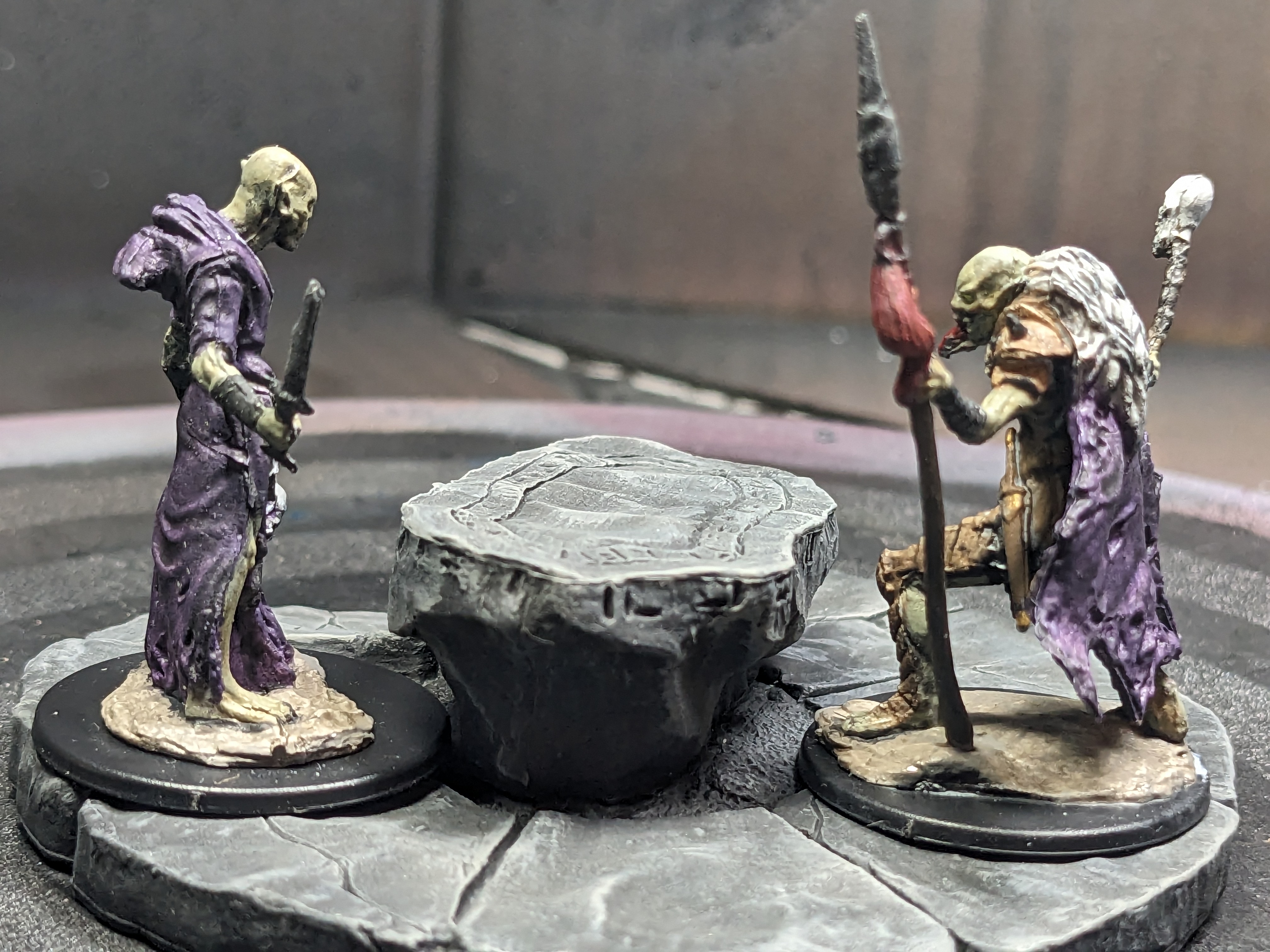
A tribute to Baur’s take on ghouls was incorporated into the Golarion setting of the Pathfinder game. The Darklands, the Underdark of Golarion, contains a dread Ghoul Court which recalls Baur’s White Kingdom. Wizkids produced a couple of pre-painted ghoul miniatures as part of the Pathfinder Battles Rusty Dragon Inn set: A ghoul cultist and a ghoul champion. These sculpts were reissued in a single blister pack of unpainted Ghouls as part of the Pathfinder Deep Cuts Wave 7 release. I snapped these up thinking they would work pretty well for leaders of the Eaters of the Dead.

I tackled these figures by starting with a zenithal undercoat, then used Reaper Ghoul Flesh and Imperial Purple for the base coats. My Army Painter Regiment and Insane Detail brushes got some pretty good workouts as I finished these miniatures off.

Conceptually, civilized ghouls overlap somewhat with vampires. To distinguish the two, I think of vampires as cursed, wretched creatures clinging to the remnants of their lost humanity, hating their damned condition and fearing to die the true death. Even cultists of Orcus are terrified of death, perhaps because they know all-too-well what torments await them in the Abyss.

Ghouls, in contrast, are eerie post-humanist creatures who actually embrace their undead state: they consider themselves to be transcendent, blessed to have surpassed their mortal flesh. They view humanity with alien detachment and callousness. Ghouls neither fear nor fetishize death: as worshippers of the mysterious Charnel God, true death represents just one more transformation for them into blissful oblivion.

These two miniatures are useful for representing leaders of the Eaters of the Dead faction. Charnel Captains are military commanders of ghoul forces. Charnel Priests are clerics of Mordiggian, philosopher-advisors to ghoul communities. Both captains and priests are usually accompanied by lesser ghouls or ghasts. The sacrificial altar they are posed with was from the “Mythos Expansion” of the Reaper Bones 3 Kickerstarter. This model is another Kevin Williams sculpture.

In the Great Dungeon, areas controlled by the ghouls are filled with the faint scent of musty cinnamon and the muffled ringing of chimes. This curious detail is a shout-out to the Ssú of the Empire of the Petal Throne setting. “The Enemies of Man” are creatures so feared within Tékumel that new PCs quickly learn to flee at first whiff of cinnamon or the sound of bells.

The following text is Open Game Content.

3.5e

These stat blocks use an abbreviated format that omits extraneous or redundant elements. Listen and Spot skills, for example, are detailed on the Senses line and not repeated on the Skills line; Feats that are “always on” like Improved Initiative or Toughness are incorporated into the stat block and not listed on the Feat line.

The Charnel Captain was created by applying the elite ability score array to a standard ghoul and adding 4 levels of fighter.

Charnel Captain CR 5

CE Medium undead

Init +4; Senses darkvision 60 ft.; Listen +3, Spot +8

Language Common

Defense

AC 21, touch 14, flat-footed 16

hp 40 (6 HD)

Fort +5, Ref +6, Will +8

Immune undead traits; Resist turn resistance +2

Offense

Spd 30 ft.; Balance +8, Climb +8, Jump +8

Melee bite +9 (1d6+4 plus paralysis), 2 claws +8 (1d3+4 plus paralysis)

Ranged mwk composite shortbow +9 (1d6+4/x3)

Special Attacks ghoul fever (DC 13)

Statistics

Str 18, Dex 18, Con –, Int 12, Wis 16, Cha 15

Base Atk +5; Grp +9

Feats Dodge, Mobility, Spring Attack

Skills Hide +8, Intimidate +9, Move Silently +8

Combat Gear oil of greater magic fang (+3), potion of displacement; Other Gear +1 chain shirt, cloak of resistance +1, masterwork composite shortbow (18 Str) with 40 arrows

Special Abilities

Ghoul Fever (Su) Disease—bite, Fortitude DC 13, incubation period 1 day, damage 1d3 Con and 1d3 Dex.

Paralysis (Ex) DC 13 Fortitude, paralysis 1d4+1 rounds. Elves have immunity to this paralysis.

The Charnel Priest was created by applying the elite ability score array to a standard ghoul and adding 5 levels of cleric. Clerics of the Charnel God (favored weapon: dagger) have access to the Death, Evil, and Knowledge domains.

Charnel Priest CR 5

CE Medium undead

Init +2; Senses darkvision 60 ft.; Listen +5, Spot +10

Language Common

Defense

AC 20, touch 12, flat-footed 18

hp 41 (7 HD)

Fort +4, Ref +3, Will +12

Immune undead traits; Resist turn resistance +2

Offense

Spd 20 ft.; Balance +4, Climb +4, Jump -2

Melee bite +6 (1d6+2 plus paralysis), 2 claws +4 (1d3+1 plus paralysis)

Special Attacks death touch 1/day (+6 melee touch), ghoul fever (DC 14), rebuke undead 6/day (+3, 2d6+8, 5th)

Spells Prepared (CL 5th, 6th for evil spells)

3rd—animate deadD, bestow curse (+6 melee touch, DC 18), deeper darkness

2nd—death knellD (DC 17), hold person (DC 17), shatter (DC 17), silence

1st—bane (DC 16), cause fearD (DC 16), death watch, divine favor, doom (DC 16), shield of faith

0—detect magic, guidance, read magic, resistance, virtue

D Domain spell; Domains death, evil

Statistics

Str 15, Dex 14, Con –, Int 14, Wis 20, Cha 16

Base Atk +4; Grp +6

Skills Concentration +10 (+14 casting defensively), Hide +6, Knowledge (arcana) +7, Knowledge (religion) +7, Move Silently +6, Spellcraft +9

SQ spontaneous casting (inflict spells)

Combat Gear oil of darkness, scroll of divine power, scroll of mass inflict moderate wounds; Other Gear +1 breastplate, holy symbol (dagger), funeral-purple robes, silver skull-like mask

Special Abilities

Death Touch (Su) Once per day the ghoul priest may use a death touch against a living creature (+6 melee touch). If successful, roll 5d6; if this is greater than the creature’s current hit points, it dies (no save).

Ghoul Fever (Su) Disease—bite, Fortitude DC 14, incubation period 1 day, damage 1d3 Con and 1d3 Dex.

Paralysis (Ex) DC 14 Fortitude, paralysis 1d4+1 rounds. Elves have immunity to this paralysis.

5e

Ghoul Captain
Medium undead, chaotic evil
Armor Class 15 (studded leather)
Hit Points 78 (12d8 + 24)
Speed 30 ft.
StrDexConIntWisCha
16 (+3)16 (+3)15 (+2)12 (+1)13 (+1)11 (+0)
Senses darkvision 60 ft.; passive Perception 13
Languages Common
Challenge 4 (1,100 XP)
Damage Resistances necrotic
Damage Immunities poison
Condition Immunities charmed, exhaustion, poisoned
Actions
Multiattack. The charnel captain makes either three melee attacks—one with its bite and two with its claws—or three ranged attacks with its longbow.
Bite. Melee Weapon Attack: +5 to hit, reach 5 ft., one target. Hit: 10 (2d6 + 3) piercing damage.
Claws. Melee Weapon Attack: +5 to hit, reach 5 ft., one target. Hit: 7 (1d8 + 3) slashing damage. If the target is a creature other than an elf or undead, it must succeed on a DC 10 Constitution saving throw or be paralyzed for 1 minute. The target can repeat the saving throw at the end of each of its turns, ending the effect on itself on a success.
Longbow. Ranged Weapon Attack: +5 to hit, range 150/600 ft., one target. Hit: 7 (1d8 + 3) piercing damage.
Charnel Priest
Medium undead, chaotic evil
Armor Class 16 (breastplate)
Hit Points 75 (10d8 + 30)
Speed 30 ft.
StrDexConIntWisCha
15 (+2)14 (+2)16 (+3)14 (+2)16 (+3)12 (+1)
Damage Immunities. necrotic, poison.
Condition Immunities. charmed, exhaustion, poisoned.
Senses darkvision 60 ft., passive Perception 13
Languages Common
Challenge 4 (1,100 XP)
Spellcasting: The ghoul priest is a 5th-level spellcaster. Its spellcasting ability is Wisdom (spell save DC 15, +7 to hit with spell attacks). The priest has the following cleric spells prepared:

Cantrips (at will)—guidance, sacred flame, thaumaturgy
1st level (4 slots)—bane, inflict wounds, shield of faith
2nd level (3 slots)—hold person, silence
3rd level (2 slots)—animate dead, bestow curse

Actions
Multiattack. The charnel priest makes three melee attacks: one with its bite and two with its claws.
Bite. Melee Weapon Attack: +4 to hit, reach 5 ft., one target. Hit: 9 (2d6 + 2) piercing damage.
Claws. Melee Weapon Attack: +4 to hit, reach 5 ft., one target. Hit: 7 (2d4 + 2) slashing damage. If the target is a creature other than an elf or undead, it must succeed on a DC 10 Constitution saving throw or be paralyzed for 1 minute. The target can repeat the saving throw at the end of each of its turns, ending the effect on itself on a success
Channel Negative Energy The charnel priest magically unleashes negative energy. Living creatures within 60 feet of the charnel priest, including ones behind barriers and around corners, can’t regain hit points until the end of the charnel priest’s next turn.

OPEN GAME LICENSE Version 1.0a

The following text is the property of Wizards of the Coast, Inc. and is Copyright 2000 Wizards of the Coast, Inc (“Wizards”). All Rights Reserved.

Wednesday, November 22, 2023

Undead Gnolls

There is a great resemblance between gnolls and hyenas. Gnolls have greenish gray skins, darker near the muzzle, with reddish gray to dull yellow mane. Eyes are dull black and nails are amber colored. Their armor is of horn, metal plates, and leather; like their fur capes and vests, it is shabby, and the latter are moth-eaten and dingy, being brown, black or grayish pelts.—1e Monster Manual (1977).

Gnolls are arguably the most distinctive of the evil humanoids from early Dungeons and Dragons. While kobolds, goblins, hobgoblins, orcs, and bugbears all seem to spring from common Northern European/Tolkien roots, hyena-headed, demon-worshiping gnolls seem to originate from someplace altogether different. 

While many of the classic humanoid monsters are first described in Chainmail (1972), gnolls debut in Dungeons and Dragons Book II: Monsters and Treasures (1974): 

A cross between Gnomes and Trolls (… perhaps, Lord Sunsany [sic] did not really make it all that clear) with +2 morale. Otherwise they are similar to Hobgoblins, although the Gnoll king and his bodyguard of from 1–4 will fight as Trolls but lack regenerative power.

Note that none of the distinctive features of the gnolls as described in the 1e Monster Manual can be found here. A Greg Bell illustration of a “Gnoll,” on page 10 just looks like a generic, pointed-eared humanoid.

Lord Dunsany, the Anglo-Irish writer, is listed as “Inspirational and Educational Material” in Appendix N of the 1e Dungeon Master’s Guide (1979). “Gnoles” are mentioned in his enigmatic short story “How Nuth Would Have Practiced his Art upon the Gnoles” from The Book of Wonder (1912): 

No track led up to the sinister gloom of the trees, either of men or cattle; not even a poacher had been there snaring elves for over a hundred years. You did not trespass in the dells of the gnoles.

Though [spoiler alert] gnoles are never actually seen in Dunsany’s story, they appear to be some manner of forest-dwelling bogeymen. Although I’ve never been sure how influential Dunsany really was on him, Gygax seemed to have had a special fondness for gnolls. They appear in the “Example of the Referee Moderating a Dungeon Expedition” from OD&D Book III, The Underworld and Wilderness Adventures. The party encounters a room with “a half-dozen gnolls,” but although Gygax describes the physical dimensions of the room and its contents in great detail, he doesn’t actually describe what a gnoll looks like. 

Gygax also developed a new gnoll card to the Dungeon! Boardgame. He mentions gnolls in his short story “The Search for the Gnome Cache,” from The Dragon 3 (October 1976). Writing under the pseudonym “Garrison Ernst,” Gygax portrays them much like the bogeymen of Dunsany:

Yer ain’t heard ‘bout that terribul country? Why, airs most slimey great beastswhatlives in the waters o’Nyrn, an’ the hills above the lake are cursed too! Ain’t no folks lives there—only bad things like gnolls.

Enter Yeenoghu

So where did the familiar hyena-headed gnolls of the 1e Monster Manual come from? I can’t find a direct source, but here’s a promising but extremely obscure lead: Strategic Preview Sub-titled TSR Jobbies #5 (Summer 1976), a TSR in-house newsletter produced in vanishingly small numbers. As detailed by Frank Mentzer over at Dragonsfoot, this newsletter featured the very first appearance of Yeenoghu, and most of the information closely mirrors the description from the 1e Monster Manual:

Yeenoghu resembles a human in general form, except that his head is a hyena’s, his chest canine in form, his hands paw-like, and his feet are pawed.

The Strategic Preview entry differs mainly on one point, but it’s a doozy: Yeenoghu is described as “The Demon Lord of Orcs.”

So at some point between Strategic Preview 5 and the publication of the Monster Manual one year later, someone decided to connect Yeenoghu with gnolls, and to have gnolls resemble their hyena-headed demonic patron.

So who did it? Gygax is the presumptive answer, but as Mentzer pointed out in a followup post, “Throughout the 4 Strategic Previews, there is no mention of authors, artists, or copyrights. [Determining an author for] the writing is trickier, and this entry is not written in HighGax.”

I have sometimes wondered if Yeenoghu might actually be the creation of Rob Kuntz. I don’t have anything to support that idea beyond “feel.” The name Yeenoghu, the exoticism of his appearance, the connection to ghouls all feel inspired by the pulp writer Clark Ashton Smith. And while Gygax supposedly hadn’t read him, Kuntz is a well known fan of CAS.

Earlier this year James Maliszewski posted a nice Grognardia entry on Clark Ashton Smith’s short story "The Tomb-Spawn," which describes monsters that might be a direct inspiration for the hyena-headed gnoll: the Ghorii.

The story is part of CAS’s Zothique cycle of weird fiction. While it’s not entirely clear whether the Ghorii are a tribe of bestial humans or inhuman monsters, they certainly sound gnollish in nature:

Into this waste, which was seemingly unpeopled and void of life, the caravan went warily. Urging their camels to a swift trot in the narrow, deep-walled ravines, the merchants made ready their spears and claymores and scanned the barren ridges with anxious eyes. For here, in hidden caves, there lurked a wild and half-bestial people, known as the Ghorii. Akin to the ghouls and jackals, they were eaters of carrion; and also they were anthropophagi, subsisting by preference on the bodies of travelers, and drinking their blood in lieu of water or wine. They were dreaded by all who had occasion to journey between Yoros and Tasuun.

* * * * *

[The] gully swarmed and seethed with the hideous earth-brown bodies of the Ghorii, who appeared instantaneously on all sides, leaping wolfishly from the rocky slopes or flinging themselves like panthers from the high ledges.

These ghoulish apparitions were unspeakably ferocious and agile. Uttering no sound, other than a sort of hoarse coughing and spitting, and armed only with their double rows of pointed teeth and their sickle-like talons, they poured over the caravan in a climbing wave.

Whether created by Gygax or Kuntz, the 1e Monster Manual firmly established the look of gnolls, their connection to ghouls and their demonic patron, Yeenoghu.

Amongst the ranks of demon princes, Yeenoghu is one of the most powerful and most feared. There will normally be 66 gnolls of the strongest sort … in attendance upon Yeenoghu, and if he is alone he can summon from 6–66 in one turn. As this demon prince also receives homage from the King of Ghouls, he can similarly summon from 6–16 ghouls if he so desires.

Fourth Edition introduced the witherling in the Monster Manual 2 (2009), a form of undead gnoll. The concept makes a lot of sense, but I find the design and artwork a bit underwhelming. Fifth edition brought the witherlings back in Volo’s Guide to Monsters (2016), and the artwork really sold this monster to me. When WizKids introduced witherling miniatures as part of Wave 15 of their Nolzur’s Marvelous Miniatures line, I knew I had to get these.

These were really fun miniatures to paint. I sprayed a zentihal undercoat of black which helped establish shading; in retrospect I should have done a second coat of white on top of this. 

I then used several washes of different Army Painter Quickshade tones, which helped create a pallid, desiccated look that reasonably matched the artwork in Volo’s. Using washes also helped preserve the fine details of the skeletal areas, which sometimes get lost with chalky white paints.

I was fairly happy with how these miniatures came out and look forward to using these in an upcoming game.

Undead Gnolls in the Great Dungeon

The gnolls of the Great Dungeon venerate the foul demon lord Yughooragh, who also “commands the service of hyenas, ghouls, ghasts, and trolls.” As a sign of his power, he grants many gnoll shaman the ability to create and command undead gnolls, which assume a variety of horrid forms. Slain shamans or chieftains especially favored by Yughooragh are sometimes called back from the Abyss as ghoul-kissed gnolls.

For 5e games, I would simply use Witherlings as described in Volo’s. But in a 3e game I would make use of the many undead templates available. Green Ronin’s Advanced Bestiary provides a handy Dread Ghoul template which suits our purposes quite well. The following text is Open Game Content.

Undead Gnolls

Ghoul-Kissed Gnoll CR 2

CE Medium undead (augmented humanoid, gnoll)

Init +2; Senses darkvision 60 ft., scent; Listen +4, Spot +5

Languages Gnoll

Defense

AC 15, touch 12, flat-footed 13

hp 13 (2 HD)

Fort +3, Ref +1, Will +2

Special Defenses turn resistance +2

Offense

Spd 30 ft., climb 30 ft.

Melee bite +4 (1d6+3 plus paralysis), 2 claws +2 (1d3+1 plus paralysis)

Special Attacks command ghouls, create spawn

Statistics

Str 17, Dex 14, Con –, Int 10, Wis 15, Cha 10

Base Atk +1; Grp +5

Feats Multiattack, Track B

Skills Climb +11, Survival +10

Special Abilities

Command Ghouls (Su) A ghoul-kissed gnoll can automatically command all normal ghouls within 30 feet as a free action. Normal ghouls never attack a ghoul-kissed gnoll unless compelled.

Create Spawn (Su) In most cases, ghoul-kissed gnolls feast on the bodies of the fallen. However, any creature killed by a ghoul-kissed gnoll that lies undisturbed until the next midnight rises as a dread ghoul at that time. The new dread ghoul is not under the control of its creator. A protection from evil or gentle repose spell cast on the corpse prevents this.

Paralysis (Ex) A creature damaged by a ghoul-kissed gnoll’s natural attack must succeed on a DC 11 Fortitude save or be paralyzed for 1d4+1 rounds.

Scent (Ex) A ghoul-kissed gnoll can detect approaching enemies and sniff out hidden foes by sense of smell alone.

Skills A ghoul-kissed gnoll can always choose to take 10 on Climb checks, even if rushed or threatened.

Undead Traits Immune to mind-affecting effects, poison, sleep, paralysis, stunning, disease, death effects, and any effect that requires a Fortitude save unless it also works on objects or is harmless. Not subject to critical hits, nonlethal damage, ability damage to its physical ability scores, ability drain, energy drain, fatigue, exhaustion, or death from massive damage.

Skeletal Gnoll CR 1

CE Medium undead

Init +5; Senses darkvision 60 ft.; Listen +0, Spot +0

Defense

AC 18, touch 11, flat-footed 17

hp 13 (2 HD)

Fort +0, Ref +1, Will +3

Immune cold; DR 5/bludgeoning

Offense

Spd 30 ft.

Melee morningstar +3 (1d8+2)

Statistics

Str 15, Dex 12, Con –, Int –, Wis 10, Cha 1

Base Atk +1; Grp +3

Gear leather armor, heavy wooden shield, morningstar

Special Abilities

Undead Traits Immune to mind-affecting effects, poison, sleep, paralysis, stunning, disease, death effects, and any effect that requires a Fortitude save unless it also works on objects or is harmless. Not subject to critical hits, nonlethal damage, ability damage to its physical ability scores, ability drain, energy drain, fatigue, exhaustion, or death from massive damage.

Zombified Gnoll CR 1

CE Medium undead

Init -1; Senses darkvision 60 ft.; Listen +0, Spot +0

Defense

AC 16, touch 9, flat-footed 16

hp 29 (4 HD); DR 5/slashing

Fort +1, Ref +0, Will +4

Defensive Abilities undead traits

Offense

Spd 30 ft.

Melee morningstar +5 (1d8+3)

Statistics

Str 17, Dex 8, Con –, Int –, Wis 10, Cha 1

Base Atk +2; Grp +5

Gear leather armor, heavy wooden shield, morningstar

SQ single actions only

Special Abilities

Single Actions Only (Ex) Zombified gnolls have poor reflexes and can perform only a single move action or attack action each round. A zombified gnoll can move up to its speed and attack in the same round, but only if it attempts a charge.

Undead Traits Immune to mind-affecting effects, poison, sleep, paralysis, stunning, disease, death effects, and any effect that requires a Fortitude save unless it also works on objects or is harmless. Not subject to critical hits, nonlethal damage, ability damage to its physical ability scores, ability drain, energy drain, fatigue, exhaustion, or death from massive damage.

OPEN GAME LICENSE Version 1.0a

The following text is the property of Wizards of the Coast, Inc. and is Copyright 2000 Wizards of the Coast, Inc (“Wizards”). All Rights Reserved.

Wednesday, October 11, 2023

Bugbears of the Great Dungeon

As I was writing my previous post about Warhammer, I dug out a couple of old Citadel bugbear miniatures, which had been cast as part of Citadel’s brief but much loved AD&D line. These figures had been stuck in a display case for almost 40 years, and pulling them out I was struck by how well they held up. The sculptor, Jes Goodwin, was able to capture many fine little details, including the minute stitching around the pointed leather cap on one bugbear.

I was also reminded that these bugbears were probably the last miniatures I had worked on during my initial burst of painting—and that they were never quite finished. I vaguely remember that at the time my paints had started to run out or go dry, and my brushes were all trashed, making working on all the small bugbeary details extremely frustrating. I’m pretty sure I got them to a “close enough” stage and then set my painting aside for what ended up being a very long hiatus.

As I looked more closely at these old miniatures, I began to think they could finished off without too much trouble. I also began to wonder what some modern paints and tone washes would be able to do for them. Rather than strip these miniatures down to the metal, I just started painting on top of my old work. Like Rip Van Winkle, these great little miniatures slowly began to come back to life. I can’t explain why it feels so satisfying to complete these long-neglected figures, but it does.

Bugbears of the Great Dungeon

BUGBEARS are giant shaggy goblins hailing from the ancient Boundary Mountains. Unlike their goblin and hobgoblin kin, the bugbears were never subjugated by the elves of old Norumbega. Today they live in small, fiercely independent bands scattered across the North. In the Great Dungeon, one particularly ornery clan forms a notable faction on the middle levels.

I use a standard stat block to describe different factions in the Great Dungeon, like so:

Bugbears of the Boundary Mountains CE

A clan of treacherous bugbears ready to exploit allies and ambush enemies.

Allies Dungmarket goblins

Enemies Orcs of the Shattered Bone, The Reapers

Locations Grumlug’s Lair (6th), The Back Landing (4th, outpost), The Whispering Halls (5th, lair), The Bleak Rotunda (5th, outpost)

Names

Names Barggut, Bedrut, Bruztig, Garyag, Hruguyed, Khotgub, Meraog, Rudgul, Rudlub, Rudorb, Sudurb, Sudya

Roster

Leader Chief Grumlug (CE male bugbear rogue 5/fighter 2)

Population 37 bugbears plus 15 noncombatant adults and 18 young

Roster List

9th (7,200 xp)—Chief Grumlug (U)

7th (3,600 xp)—bugbear leader

5th (1,800 xp)—bugbear scout, bugbear shaman

3rd (900 xp)—bugbear sergeant

2nd (600 xp)—bugbear

Below are 3.5e and 5e stat blocks for members of the Bugbears of the Boundary Mountains faction. The following text is Open Game Content.

3.5e

The following table can be used to generate random bugbear encounters:

Bugbear Encounters
d% Encounter Average EL
01–33 1d3+1 bugbears 5
34–41 1d2 bugbear leaders 8
42–58 1d3 bugbear scouts 7
59–83 1d3+1 bugbear sergeants 6
84–00 1d2 bugbear shamans 6

Individual statblocks follow. These use an abbreviated format: feats that are already incorporated into the statblock such as Toughness are not enumerated in the Feats line. Likewise skills that appear elsewhere, such as Listen and Spot, are not repeated in the Skill line.

Bugbear CR 2

CE Medium humanoid (goblinoid)

Init +1; Senses darkvision 60 ft., scent; Listen +4, Spot +4

Languages Goblin, Common

Defense

AC 17, touch 11, flat-footed 16

hp 16 (3 HD)

Fort +2, Ref +4, Will +1

Offense

Spd 30 ft.; Climb +3

Melee morningstar +5 (1d8+2)

Ranged javelin +3 (1d6+2)

Statistics

Str 15, Dex 12, Con 13, Int 10, Wis 10, Cha 9

Base Atk +2; Grp +4

Skills Hide +4, Move Silently +6

Gear leather armor, light wooden shield, morningstar, 2 javelins

Bugbear Chief CR 9

Male bugbear fighter 2/rogue 5

CE Medium humanoid (goblinoid)

Init +4; Senses darkvision 60 ft., scent; Listen +8, Spot +8

Languages Goblin, Common

Defense

AC 24, touch 14, flat-footed 20

hp 85 (10 HD)

Fort +10, Ref +12, Will +4

Defensive Abilities evasion, uncanny dodge, trap sense +1

Offense

Spd 30 ft.; Balance +11, Climb +10, Jump +6, Tumble +9

Melee +1 longsword +13/+8 (1d8+5/19–20)

Ranged +1 throwing axe +12 (1d6+5)

Special Attacks sneak attack +3d6

Statistics

Str 18, Dex 19, Con 18, Int 10, Wis 12, Cha 8

Base Atk +7; Grp +11

Feats Combat Reflexes, Deadly Precision*, Dodge, Mobility

Skills Hide +14, Move Silently +23, Search +8, Survival +1 (+3 following tracks)

SQ trapfinding

Combat Gear potion of haste; Gear +1 studded leather armor, +1 light wooden shield, +1 longsword, +1 throwing axe, amulet of natural armor +1, boots of elvenkind, cloak of resistance +1

Abilities

Deadly Precision: With this feat the bugbear chief can reroll any result of 1 on his sneak attack’s extra damage dice. The chief must keep the result of the reroll, even if it is another 1.

Bugbear Leader CR 7

CE Medium humanoid (goblinoid)

Init +4; Senses darkvision 60 ft., scent; Listen +4, Spot +4

Languages Goblin, Common

Defense

AC 17, touch 10, flat-footed 17

hp 76 (8 HD)

Fort +9, Ref +4, Will +4

Offense

Spd 30 ft.; Climb +10

Melee +1 morningstar +13/+8 (1d8+7)

Ranged mwk javelin +8 (1d6+4)

Statistics

Str 18, Dex 10, Con 18, Int 10, Wis 14, Cha 10

Base Atk +7; Grp +11

Feats Blind-Fight, Improved Shield Bash

Skills Hide +6, Intimidate +6, Move Silently +8

Combat Gear potions of cure moderate wounds and heroism; Gear leather armor, +1 light wooden shield, +1 morningstar, 2 masterwork javelins

Bugbear Scout CR 5

CE Medium humanoid (goblinoid)

Init +7; Senses darkvision 60 ft., scent; Listen +8, Spot +8

Languages Goblin, Common

Defense

AC 21, touch 13, flat-footed 17

hp 45 (6 HD)

Fort +5, Ref +9, Will +3

Defensive Abilities evasion

Offense

Spd 30 ft.; Balance +7, Climb +8, Tumble +7

Melee morningstar +9 (1d8+4)

Ranged javelin +7 (1d6+4)

Special Attacks sneak attack +2d6

Statistics

Str 18, Dex 17, Con 16, Int 10, Wis 12, Cha 6

Base Atk +4; Grp +8

Skills Hide +9, Move Silently +11

SQ trapfinding, trap sense +1

Combat Gear javelin of lightning, potion of heroism; Gear +1 leather armor, light shield, morningstar, 2 javelins

Bugbear Sergeant CR 3

CE Medium humanoid (goblinoid)

Init +2; Senses darkvision 60 ft., scent; Listen +3, Spot +3

Languages Goblin, Common

Defense

AC 18, touch 12, flat-footed 16

hp 32 (5 HD)

Fort +6, Ref +5, Will +0

Offense

Spd 30 ft.; Climb +3

Melee longsword +8 (1d8+3/19–20)

Ranged throwing axe +6 (1d6+3)

Statistics

Str 17, Dex 14, Con 14, Int 10, Wis 9, Cha 6

Base Atk +4; Grp +7

Skills Hide +5, Intimidate +2, Move Silently +7

Gear leather armor, light wooden shield, longsword, 2 throwing axes

Bugbear Shaman CR 5

CE Medium humanoid (goblinoid)

Init +3; Senses darkvision 60 ft., scent; Listen +7, Spot +7

Languages Goblin, Common

Defense

AC 21, touch 13, flat-footed 18

hp 58 (8 HD)

Fort +5, Ref +7, Will +8

Offense

Spd 30 ft.; Climb +2

Melee mwk shortspear +6 (1d6+1)

Ranged dart +5 (1d4+1)

Typical Adept Spells Prepared (CL 5th, Concentration +8)

2nd—darkness, web (DC 15)

1st—cause fear (DC 14), cure light wounds, protection from good

0—detect magic, ghost sound (DC 13), touch of fatigue (+5 melee touch, DC 13)

Statistics

Str 12, Dex 16, Con 16, Int 10, Wis 16, Cha 10

Base Atk +4; Grp +5

Skills Hide +8, Move Silently +10, Spellcraft +7, Survival +7

SQ summon familiar

Combat Gear javelin of lightning, wand of burning hands; Gear +1 studded leather armor, light wooden shield, masterwork shortspear, 2 darts

Noncombatant Bugbear CR 2

CE Medium humanoid (goblinoid)

Init +1; Senses darkvision 60 ft., scent; Listen +5, Spot +5

Languages Goblin, Common

Defense

AC 14, touch 11, flat-footed 13

hp 19 (3 HD)

Fort +3, Ref +4, Will +2

Offense

Spd 30 ft.; Climb +3,

Melee dagger +3 (1d4+1/19–20)

Statistics

Str 12, Dex 12, Con 15, Int 11, Wis 12, Cha 7

Base Atk +2; Grp +3

Skills Hide +7, Move Silently +9

Gear dagger

5e

The roster of the bugbear faction:

  • Challenge 7 (2,900 XP)—bugbear chief (Unique)
  • Challenge 5 (1,800 XP)—bugbear leader
  • Challenge 4 (1,100 XP)—bugbear scout, bugbear shaman
  • Challenge 2 (450 XP)—bugbear sergeant
  • Challenge 1 (200 XP)—bugbear

Bugbear encounters can be generated using the following table:

Bugbear Encounters
d%EncounterAverage
Challenge
01–331d3+1 bugbears4
34–411d2 bugbear leaders8
42–581d3 bugbear scouts7
59–831d3+1 bugbear sergeants6
84–001d2 bugbear shamans6

Statblocks for individuals follow.

Bugbear
Medium humanoid (goblinoid), chaotic evil
Armor Class 16 (hide armor, shield)
Hit Points 27 (5d8 + 5)
Speed 30 ft.
StrDexConIntWisCha
15 (+2)14 (+2)13 (+1)8 (-1)11 (+0)9 (-1)
Skills Stealth +6, Survival +2
Senses darkvision 60 ft., passive Perception 10
Languages Common, Goblin
Challenge 1 (200 XP)
Brute. A melee weapon deals one extra die of its damage when the bugbear hits with it (included in the attack).
Surprise Attack. If the bugbear surprises a creature and hits it with an attack during the first round of combat, the target takes an extra 7 (2d6) damage from the attack.
Actions
Javelin (Melee). Melee Weapon Attack: +4 to hit, reach 5 ft., one target. Hit: 9 (2d6 + 2) piercing damage.
Javelin (Ranged). Ranged Weapon Attack: +4 to hit, range 30/120 ft., one target. Hit: 5 (1d6 + 2) piercing damage.
Morningstar. Melee Weapon Attack: +4 to hit, reach 5 ft., one target. Hit: 11 (2d8 + 2) piercing damage.
Bugbear Chief
Medium humanoid (goblinoid), chaotic evil
Armor Class 18 (+1 studded leather armor)
Hit Points 127 (15d8 + 60)
Speed 30 ft.
StrDexConIntWisCha
18 (+4)20 (+5)18 (+4)8 (-1)12 (+1)8 (-1)
Saving Throws Dex +8, Will +4
Skills Acrobatics +8, Perception +4, Stealth +11, Survival +4
Senses darkvision 60 ft., passive Perception 14
Languages Goblin, Common
Challenge 7 (2,900 XP)
Brute. A melee weapon deals one extra die of its damage when the bugbear chief hits with it (included in the attack).
Evasion. If the bugbear chief is subjected to an effect that allows him to make a Dexterity saving throw to take only half damage, the chief instead takes no damage if he succeeds on the saving throw, and only half damage if he fails.
Sneak Attack (1/Turn). The bugbear chief deals an extra 14 (4d6) damage when he hits a target with a weapon attack and has advantage on the attack roll, or when the target is within 5 feet of an ally of the chief that isn’t incapacitated and the chief doesn’t have disadvantage on the attack roll.
Actions
Multiattack. The bugbear chief makes two melee attacks. Alternatively, he can make two ranged attacks with his handaxes.
Handaxe (Melee). Melee Weapon Attack: +7 to hit, reach 5 ft., one target. Hit: 11 (2d6 + 4) slashing damage.
Handaxe (Ranged). Ranged Weapon Attack: +7 to hit, range 30/120 ft., one target. Hit: 8 (1d6 + 4) slashing damage .
+1 Longsword. Melee Weapon Attack: +8 to hit, reach 5 ft., one target. Hit: 14 (2d8 + 5) slashing damage.
Bugbear Leader
Medium humanoid (goblinoid), chaotic evil
Armor Class 17 (breastplate, shield)
Hit Points 90 (12d8 + 48)
Speed 30 ft.
StrDexConIntWisCha
18 (+4)12 (+1)18 (+4)8 (-1)14 (+2)10 (+0)
Skills Stealth +7, Survival +5
Senses darkvision 60 ft., passive Perception 12
Languages Goblin, Common
Challenge 5 (1,800 XP)
Brute. A melee weapon deals one extra die of its damage when the bugbear leader hits with it (included in the attack).
Surprise Attack. If the bugbear leader surprises a creature and hits it with an attack during the first round of combat, the target takes an extra 7 (2d6) damage from the attack.
Actions
Javelin (Melee). Melee Weapon Attack: +7 to hit, reach 5 ft., one target. Hit: 11 (2d6 + 4) piercing damage.
Javelin (Ranged). Ranged Weapon Attack: +7 to hit, range 30/120 ft., one target. Hit: 7 (1d6 + 4) piercing damage.
Morningstar. Melee Weapon Attack: +7 to hit, reach 5 ft., one target. Hit: 13 (2d8 + 4) piercing damage.
Bugbear Scout
Medium humanoid (goblinoid), chaotic evil
Armor Class 16 (studded leather armor)
Hit Points 60 (8d8 + 24)
Speed 30 ft.
StrDexConIntWisCha
18 (+4)19 (+4)16 (+3)8 (-1)12 (+1)6 (-2)
Skills Stealth +8, Survival +3
Saving Throws Dex +6, Int +1
Senses darkvision 60 ft., passive Perception 11
Languages Goblin, Common
Challenge 4 (1,100 XP)
Brute. A melee weapon deals one extra die of its damage when the bugbear scout hits with it (included in the attack).
Sneak Attack (1/Turn). The bugbear scout deals an extra 7 (2d6) damage when it hits a target with a weapon attack and has advantage on the attack roll, or when the target is within 5 feet of an ally of the scout that isn’t incapacitated and the scout doesn’t have disadvantage on the attack roll.
Actions
Javelin (Melee). Melee Weapon Attack: +6 to hit, reach 5 ft., one target. Hit: 11 (2d6 + 4) piercing damage.
Javelin (Ranged). Ranged Weapon Attack: +6 to hit, range 30/120 ft., one target. Hit: 7 (1d6 + 4) piercing damage.
Morningstar. Melee Weapon Attack: +6 to hit, reach 5 ft., one target. Hit: 13 (2d8 + 4) piercing damage.
Bugbear Sergeant
Medium humanoid (goblinoid), chaotic evil
Armor Class 16 (leather armor, shield)
Hit Points 39 (6d8 + 12)
Speed 30 ft.
StrDexConIntWisCha
17 (+3)16 (+3)14 (+2)8 (-1)9 (-1)6 (-2)
Skills Stealth +7, Survival +1
Senses darkvision 60 ft., passive Perception 9
Languages Goblin, Common
Challenge 2 (450 XP)
Brute. A melee weapon deals one extra die of its damage when the bugbear sergeant hits with it (included in the attack).
Surprise Attack. If the bugbear sergeant surprises a creature and hits it with an attack during the first round of combat, the target takes an extra 7 (2d6) damage from the attack.
Actions
Handaxe (Melee). Melee Weapon Attack: +5 to hit, reach 5 ft., one target. Hit: 11 (2d6 + 4) slashing damage.
Handaxe (Ranged). Ranged Weapon Attack: +5 to hit, range 30/120 ft., one target. Hit: 7 (1d6 + 4) slashing damage.
Longsword. Melee Weapon Attack: +5 to hit, reach 5 ft., one target. Hit: 12 (2d8 + 3) slashing damage.
Bugbear Shaman
Medium humanoid (goblinoid), chaotic evil
Armor Class 16 (studded leather)
Hit Points 75 (10d8 + 30)
Speed 30 ft.
StrDexConIntWisCha
12 (+1)18 (+4)16 (+3)10 (+0)16 (+3)10 (+0)
Saving Throws Con +5, Wis +5
Skills Stealth +8, Survival +5
Senses darkvision 60 ft., passive Perception 13
Languages Goblin, Common
Challenge 4 (1,100 XP)
Brute. A melee weapon deals one extra die of its damage when the shaman hits with it (included in the attack).
Surprise Attack. If the shaman surprises a creature and hits it with an attack during the first round of combat, the target takes an extra 7 (2d6) damage from the attack.
Spellcasting. The bugbear shaman is a 5th-level spellcaster. Its spellcasting ability is Wisdom (spell save DC 11, +5 to hit with spell attacks). The shaman has the following cleric spells prepared:
Cantrips (at will)—guidance, sacred flame, thaumaturgy
1st level (4 slots)—bane, healing word, shield of faith
2nd level (3 slots)—hold person, silence
3rd level (2 slots)—bestow curse, mass healing word
Actions
Javelin (Melee). Melee Weapon Attack: +3 to hit, reach 5 ft., one target. Hit: 8 (2d6 + 1) piercing damage.
Javelin (Ranged). Ranged Weapon Attack: +3 to hit, range 30/120 ft., one target. Hit: 4 (1d6 + 1) piercing damage.
Noncombatant Bugbear
Medium humanoid (goblinoid), chaotic evil
Armor Class 12
Hit Points 26 (4d8 + 8)
Speed 30 ft.
StrDexConIntWisCha
12 (+1)12 (+2)15 (+2)9 (-1)12 (+1)12 (+1)
Skills Stealth +6, Survival +3
Senses darkvision 60 ft., passive Perception 10
Languages Goblin, Common
Challenge 1/2 (100 XP)
Dagger. Melee Weapon Attack: +4 to hit, reach 5 ft., one target. Hit: 3 (1d4 + 1) piercing damage.

OPEN GAME LICENSE Version 1.0a

The following text is the property of Wizards of the Coast, Inc. and is Copyright 2000 Wizards of the Coast, Inc (“Wizards”). All Rights Reserved.